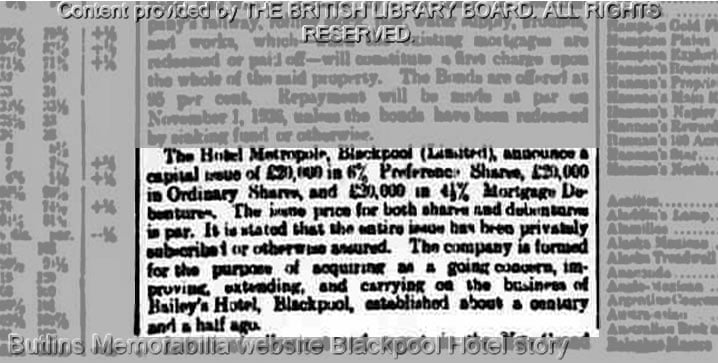
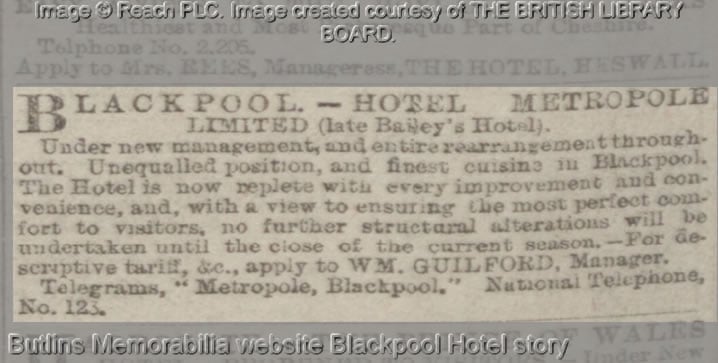
The new owners of the previous Baileys Hotel, now known as the Metropole Hotel, established a new company called The Hotel Metropole, Blackpool (Limited) to take over this historic site. The company announced an offering of £20,000 in 6% preference shares, £20,000 in ordinary shares, and £20,000 in 4½ mortgage debentures. The main purpose of forming this company was to acquire the Baileys Hotel and improve its condition, with plans to expand the hotel and sustain operations during the development phase. In July 1896, the purchase was advertised in the Manchester Courier as "Blackpool - Hotel Metropole Limited (formerly Bailey's Hotel). This shows that the hotel is now under new management and that some changes have been made to the hotel. The advertisement states that no further structural changes will be made until the end of the season, indicating that the new company aimed to start earning a profit from its reputable name and location right from the beginning. W.M. Guilford was the manager at the start of the Metropole era of the hotel and Alfredo Pinto Leite, Esq, C.E, as the director of the Hotel Metropole Blackpool Limited.
Photo credit
Image found at the British Newspaper Archive website - Link
This newspaper confirms the reports of the new company forming known as the Hotel Metropole, Blackpool Limited.
Image found at the British Newspaper Archive website - Link
Showing the announcement of the hotel now being under new management and how changes are coming to the former Baileys Hotel.
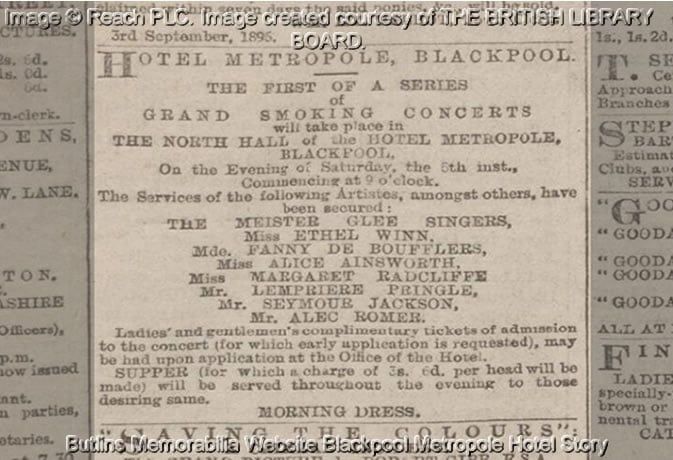
The new owners had started to advertise their new hotel and special events that were booked
Image found at the British Newspaper Archive website - Link
Showing the advertisement of the Grand Smoking Concerts at the Metropole Hotel in Blackpool.
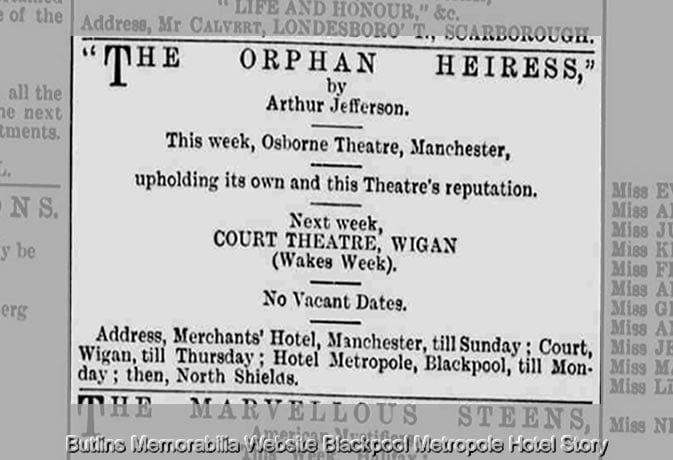
Image found at the British Newspaper Archive website - Link
Showing the advertisement of the Orphan Heiress on tour and stopping at the Metropole Hotel.
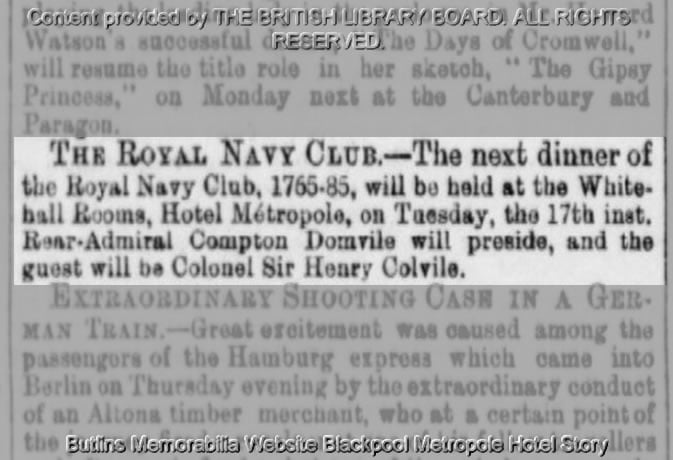
Image found at the British Newspaper Archive website - Link
The Royal Navy club details and research can be found at this website (click on these words) where you see that the club moved from Willi's Rooms to the Hotel Metropole until 1920.
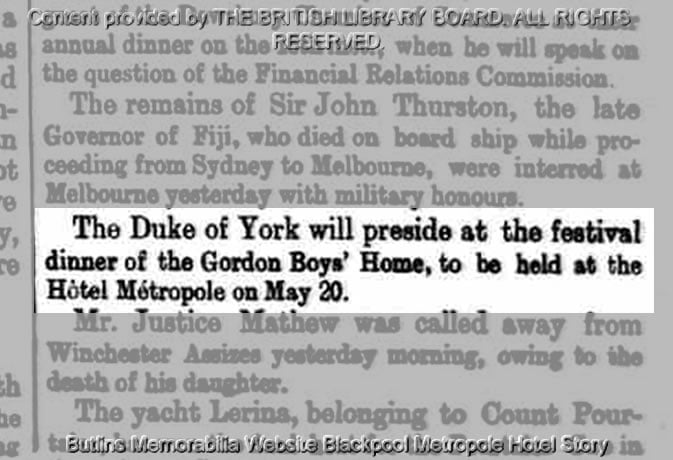
Another significant event in the Metropole Hotel's history occurred in 1897 when it hosted the festival dinner for the Gordon Boys Home. The Gordon Boys Home was established in 1885 following Queen Victoria's request for a "suitable national memorial" to honor Major-General Charles George Gordon, a legacy that endures to this day. A notable attendee at this prestigious event was a member of the royal family named George, who held the titles of Duke of York, Earl of Inverness, and Baron Killarney, and would later ascend to the throne as King of the United Kingdom on May 6, 1910.
Further Information
View more about the Major-General Charles George Gorden
View more about the Gordons Boys Home
View more about King George V
Image found at the British Newspaper Archive website - Link
The Royal Navy club details and research can be found at this website (click on these words) where you see that the club moved from Willi's Rooms to the Hotel Metropole until 1920.
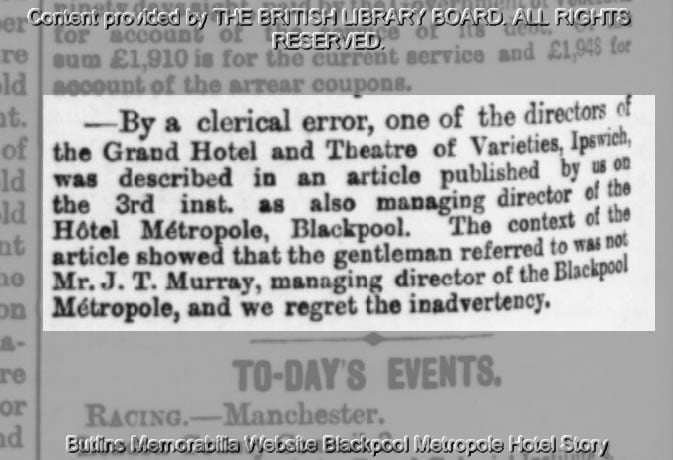
Image found at the British Newspaper Archive website - Link
An excellent find as we see in this article about a misprint on a previous published article. That article is not featured on this page however, it does confirm the connection to Mr. J. T. Murray as the managing director of the Blackpool Metropole, who is referenced in chapter one of this story.
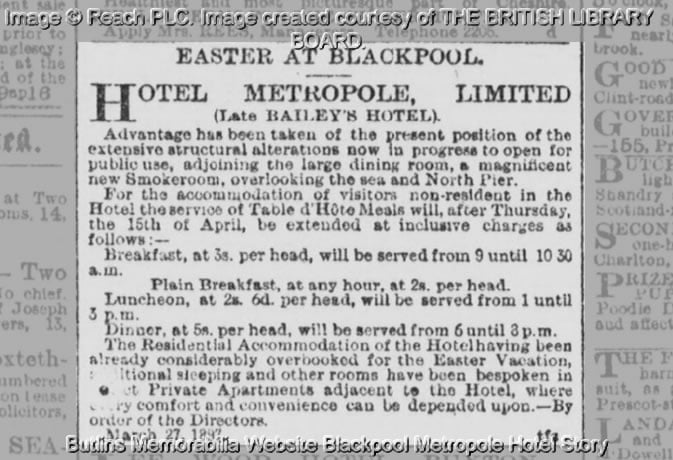
On March 27, 1897, a new advertisement informed the public that work on the hotel was ongoing with improvements. Titled "Easter at Blackpool - Hotel Metropole Limited (formerly Bailey's Hotel)," it detailed extensive structural alterations in progress while assuring that the hotel remained open for public use, featuring a large dining room and a "magnificent" new smoking room with views of the sea and North Pier. The hotel planned to open the dining room to non-residents for breakfast, priced at 3s per person (available from 9 am to 10:30 am), or a simple breakfast at 2s per person at any time. The dining room would reopen from 1 pm to 3 pm for lunch, costing 2s 6d per person. It would also serve dinner from 6 pm to 8 pm, with a price of 5s per person.
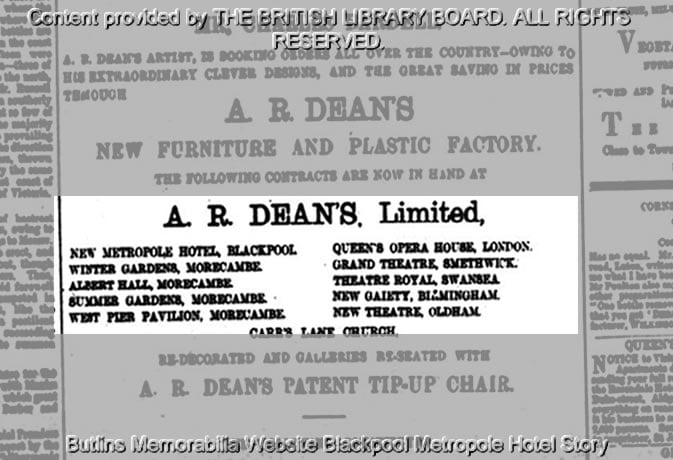
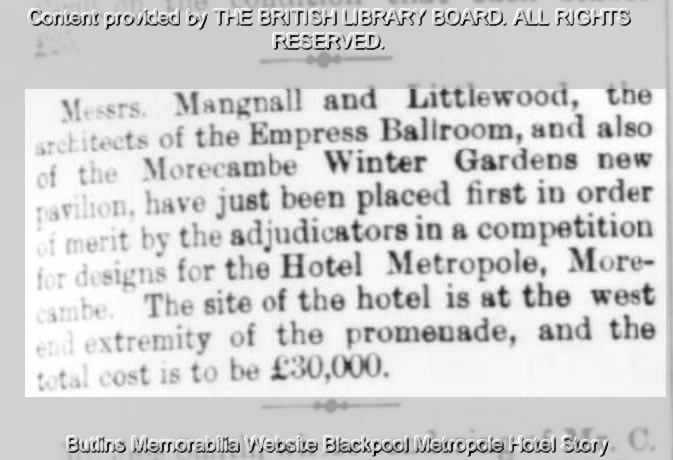
The firm selected to implement the necessary modifications at the Metropole Hotel was A. R. Dean Limited. A. R. Dean Limited specialized in various fields, including furniture manufacturing, decoration, and furnishing. With an extensive inventory of artistic carpets, curtains, and bedsteads, they would demonstrate to any company in their showrooms in the Midlands how their work can transform the perception of a business. A. R. Dean Limited lists the companies for which they have undertaken work, whether minor or major, with the Metropole Hotel noted as "New Metropole Hotel, Blackpool." Another company, called Mangnall and Littlewood was placed in first order to become the adjudicators for the designs for the Hotel Metropole.
Image found at the British Newspaper Archive website - Link
This newspaper article from the Liverpool Mercury shows that the hotel was still open during a time it was being modernised.
Image found at the British Newspaper Archive website - Link
An amazing newspaper article showing that A.R. Deans Limited was the selected company to do the works requested by the Hotel Metropole Limited.
Image found at the British Newspaper Archive website - Link
Showing you the news of the Mangnall and Littlewood architects being placed first in order for the design's of the Metropole Hotel.
Image found at the British Newspaper Archive website - Link
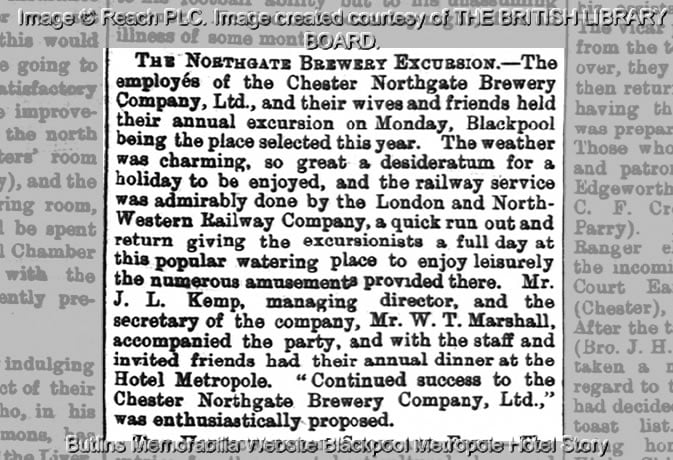
The Northgate Brewery Company Limited had heled their annual excursion at the hotel to celerbrate their success.
In 1897, the hotel served as the venue for the Poor Law conference, which saw 200 delegates attending the event in the hotel's spacious dining room. Sir J. T. Hibbert, K.C.B., was the primary host, supported by the Mayor of Blackpool, Councillor C.C. Numerous topics were addressed during this event, including the Poor Law Amendment Act of 1834. This conference would highlight areas such as;
Image found at the British Newspaper Archive website - Link
This newspaper article explains a lot into the meeting and why it was so very important. It also marks an important event at the Metropole Hotel.
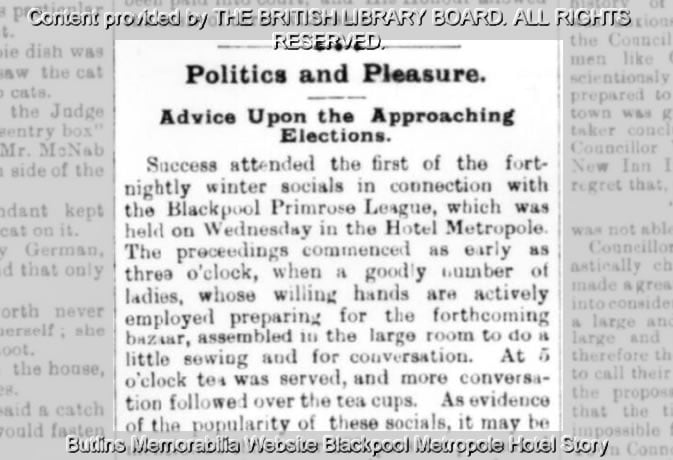
The hotel continued to be popular, with an increasing number of events reported in newspapers that attracted a large crowd of guests. On Friday, October 29th, 1897, the Blackpool Primrose League's biweekly winter socials were to commence on Wednesdays. The article indicates that the event would start at 3 PM, where conversations would be held. At 5 PM, tea was served while conversations continued, with over 200 attendees present, and a generous donor, Mrs. Louis Cohen, expressing her delight at the impressive turnout. At 7 PM, the entertainment was scheduled to begin, which included some discussions. The Primrose league is an organisation that was related to the conservative principles in Great Britain and was founded in 1883 and closed down on the 16th December 2004. You can read more about the Primrose League by clicking on these words.
Image found at the British Newspaper Archive website - Link
This newspaper article explains a great deal about the Blackpool Primrose Leagues meeting including who attended.
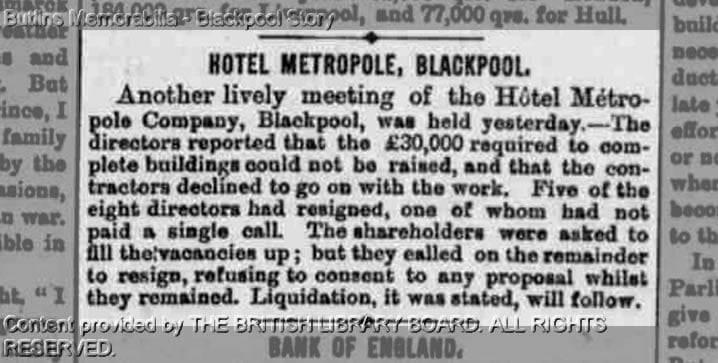
In 1897, there were initiatives to construct additional buildings and perform renovations on the hotel to bring it up to the expected standards. The goal was to position the Metropole Hotel as the must-visit location in Blackpool, offering significantly more than its competitors in the vicinity. However, in 1898, complications arose when the funding for this project was depleted, requiring an extra £30,000 to be located for the renovations. A shareholders' meeting was scheduled for April 1898 to discuss how to raise these funds to complete the unfinished work on the hotel. The amount discussed was £35,000, with shareholders approached to enhance their investments in the hotel. Unfortunately, in May 1898, another shareholders' meeting disclosed that the directors had reported a lack of success in raising the necessary funds, resulting in the resignation of between five and eight directors. There was a growing feeling that if these funds were not raised soon, the company would be forced into liquidation. Workers at this stage were no longer doing any further work until this payment situation was solved.
Image found at the British Newspaper Archive website - Link
Small article showing the meeting that was planned.
Image found at the British Newspaper Archive website - Link
The second meeting for the shareholders.
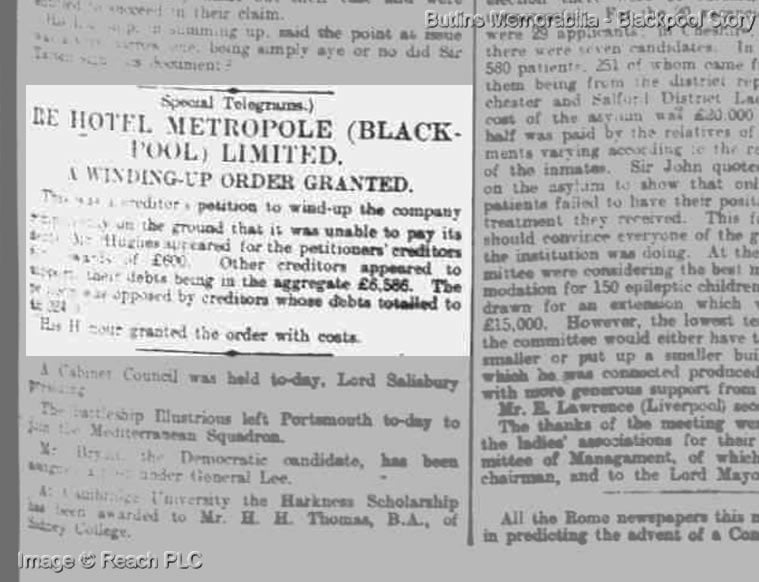
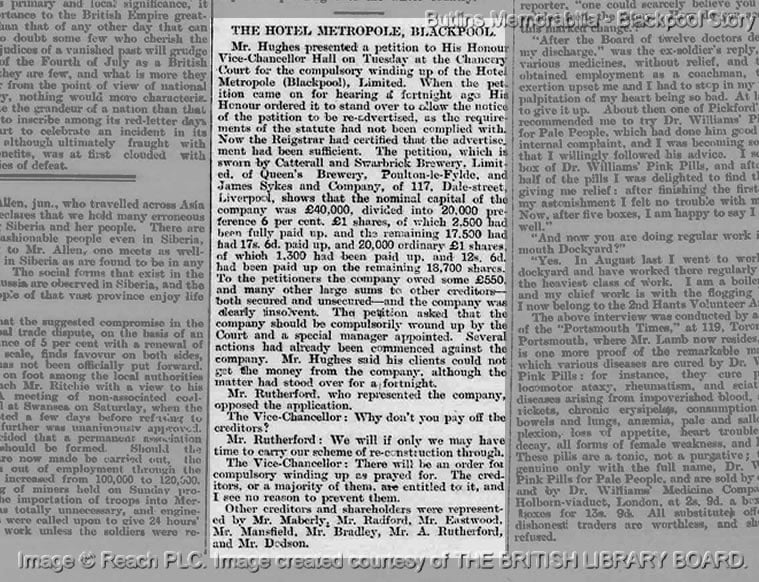
Efforts to secure the necessary funds were unsuccessful in June 1898, leading to a petition for the company's winding up being filed with Vice-Chancellor Hall in the Chancery Court of Lancashire. Mr Hughes had requested that the compulsory winding up of the Metropole Hotel Limited commence as soon as possible. He represented Catterall, Swarbrick Brewery Limited, and James Sykes in initiating the petition, which was based on a nominal capital of £40,000. The petition detailed outstanding debts owed to creditors, both secured and unsecured amounts. A request was made for the petition to proceed with the appointment of a special manager. Mr Hughes explained that a receiver and manager were in control of the hotel on behalf of the debenture holders. They clarified that there would be a surplus after the payments to the debenture holders, which should allow for this situation to be resolved.
Mr Rutherford acted on behalf of those who opposed the winding-up petition for the company. It was noted that two advertisements had been made concerning this petition: one was for the application for supervision, and the other was specifically for the petition. The evidence that Mr Rutherford provided to the court prompted the Vice Chancellor to inquire about the court's proceedings. Upon reviewing the circumstances and recognising that there was a representative contesting the winding-up petition, the Vice Chancellor opted to pause the proceedings for another two weeks to allow for the appropriate advertisements to be presented for the parties involved.
Image found at the British Newspaper Archive website - Link
Detailing more about the proceedings.
Image found at the British Newspaper Archive website - Link
Advertisement showing the petition of winding up the company.
Image found at the British Newspaper Archive website - Link
Explaining further details about the winding up of the company.
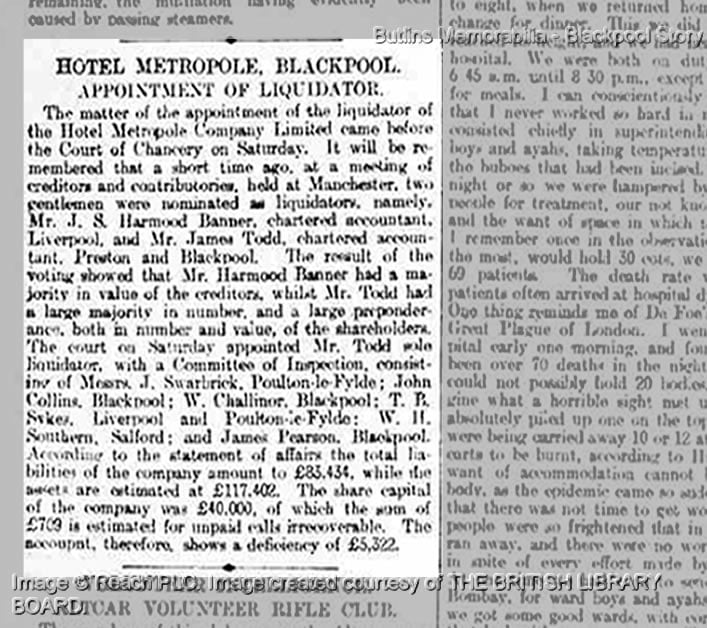
In September 1898, Mr. J.S. Harmood Banner and Mr. James Todd, both chartered accountants, were designated as liquidators from the meeting mentioned above. Special voting revealed that Mr. Harmood Banner had the majority of creditors in value, while Mr. James Tood would possess a large majority and significant preponderance in value representing the shareholders. The court determined that Mr. Todd would act as the sole liquidator, with a committee of inspection that included J Swarbrick from Poulton-le-Fylde, John Collins from Blackpool, W Challinor from Blackpool, T.B. Sykes from Liverpool, W.H. Southern from Salford, and James Pearson from Blackpool. The court documents indicated that the amount to be found was £83,434, with assets amounting to £117,402.
Image found at the British Newspaper Archive website - Link
Showing more information about the liquidation.
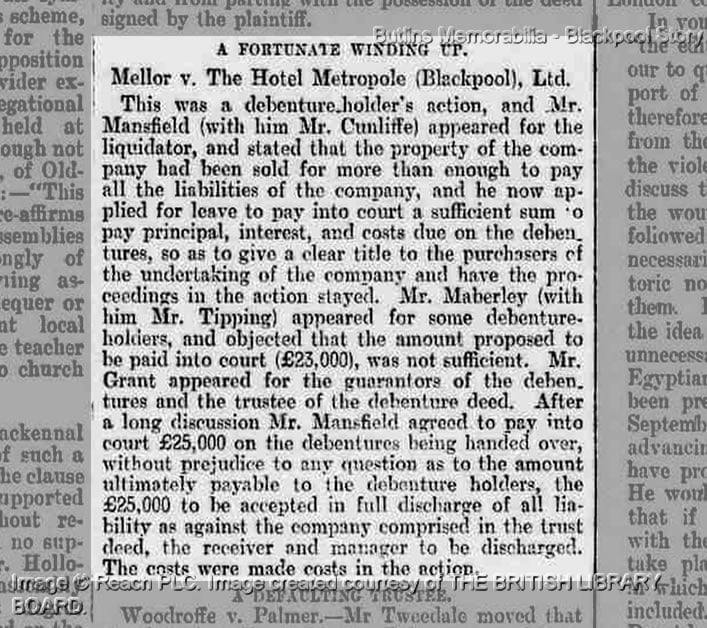
In October 1898, Mr. Mansfield and Mr. Cunliffe would appear in court as representatives of the liquidator, indicating that the company had been sold with enough capital to cover its liabilities. Nevertheless, Mr. Maberley and Mr. Tipping opposed the proposed amount of £23,000, claiming it was insufficient. Mr. Grant was also in attendance, representing the guarantors of the debentures and deed. Following a lengthy discussion, Mr. Mansfield agreed to pay the court £25,000 to obtain a complete discharge of all liabilities against the company as specified in the trust deed.
Image found at the British Newspaper Archive website - Link
Discussing the new ownership and how it would help solve a great deal of problems.
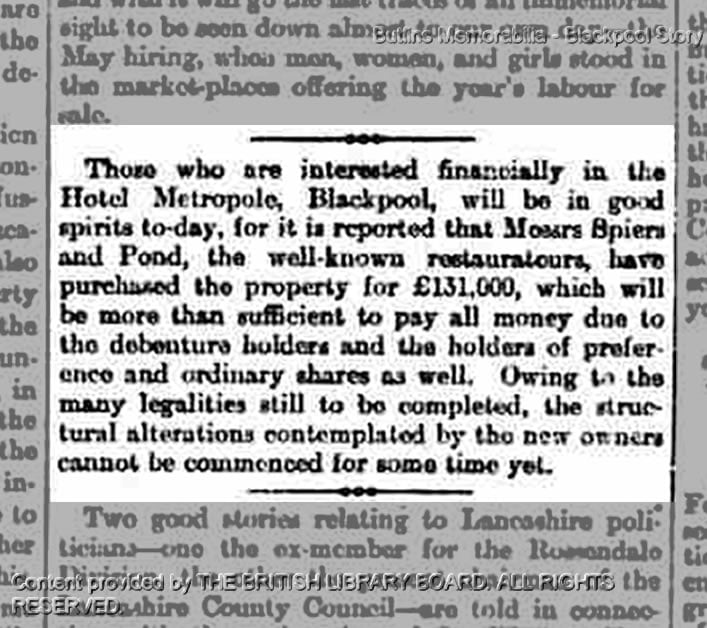
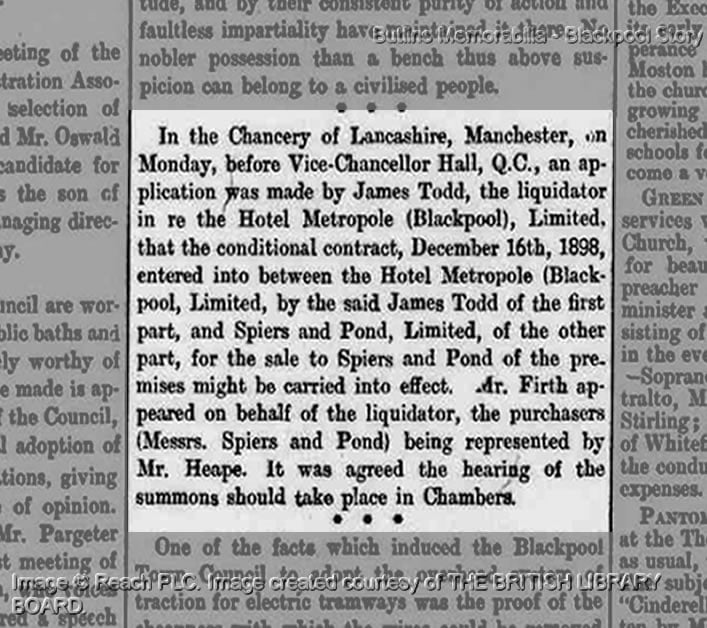
On the 19th of December 1898, it was reported that Spires and Pond, a well-known company in the restaurant industry, had made an approach to buy the hotel. They offered £131,000, which would settle all existing debts. However, the transition to new ownership would require some time due to legal proceedings. On December 23, 1898, Mr. Heape was appointed to represent Spires and Pond in discussions with Vice-Chancellor Hall in Chancerys, Lanshire, regarding the purchase. Mr. James Tood would also attend to present the purchase offer and explain how it would help resolve the financial challenges facing the business.
Image found at the British Newspaper Archive website - Link
The Northern Daily explains more about the Spires and Pond company.
Image found at the British Newspaper Archive website - Link
In this small newspaper article, we see the new company coming forward in interest to purchase the hotel.
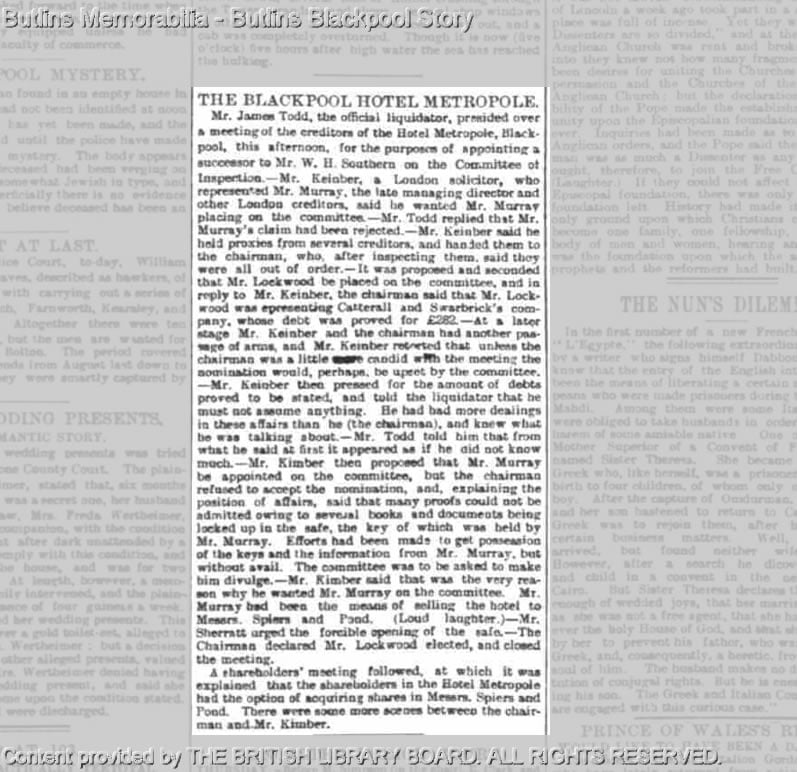
On Thursday, the 12th of January 1899, Mr James Todd, serving as the official liquidator, participated in a meeting with creditors to address the appointment of a successor to Mr W. H. Southern on the inspection committee. The reasons for Mr W. H. Southern's replacement are unclear. The conversation involved a gentleman named Mr Kimber, a solicitor based in London, who represented Mr Murray, the late managing director, and other creditors in London. Mr Kimber requested that Mr Murray be appointed as the replacement and become a member of the committee, a proposal that was turned down. He maintained that Mr Murray would have been the right choice for this role, given his experience of the necessary aspects for the inspections and held several proxies from several creditors. With this evidence handed to the chairman, a decision was made that the documents were "all out of order".
With Mr Murray's claim being denied, Mr Kimber suggested that a gentleman named Mr Lockwood should be proposed as an alternative candidate for the committee. However, the chairman pointed out that Mr Lockwood was already representing the Catterall and Swarbricks company regarding a debt of £282. The discussion continued with arguments from both sides about the representative to succeed Mr W. H. Southern, but no agreement was reached as Mr Kimber insisted on addressing the outstanding debts that needed resolution. The conversation persisted until Mr Kimber returned to the nomination of Mr Murray for the committee position. Nevertheless, the chairman continued to reject this nomination, explaining that "many proofs could not be admitted owing to several books and documents being locked up in the safe, the key of which was held by Mr Murray. Efforts had been made to get possession of the keys and the information from Mr Murray, but without avail.
The dialogue carried on, filled with laughter when Mr Kimber remarked that the reason for this was that Mr Murray had the means to sell the hotel to Spiers and Pond Limited. Another gentleman, Mr Sherratt, then requested that the safe be forcibly opened, which caused the chairman to rethink his decision and appoint Mr Lockwood as the newly elected member of the committee, leading to the meeting's conclusion. This is a crucial moment in the hotel's history as it reveals key figures in the story and indicates that shortly after this meeting, shareholders would engage in discussions about acquiring shares in Spiers and Pond Limited. It also highlights a conflict of interest between Mr Kimber and the chairman, suggesting that there was another narrative in the background that many were unaware of. I find this to be a captivating aspect of the hotel's history, marking an important turning point for the Metropole Hotel in Blackpool.
Image found at the British Newspaper Archive website - Link
Explain the story of this important meeting in 1899.
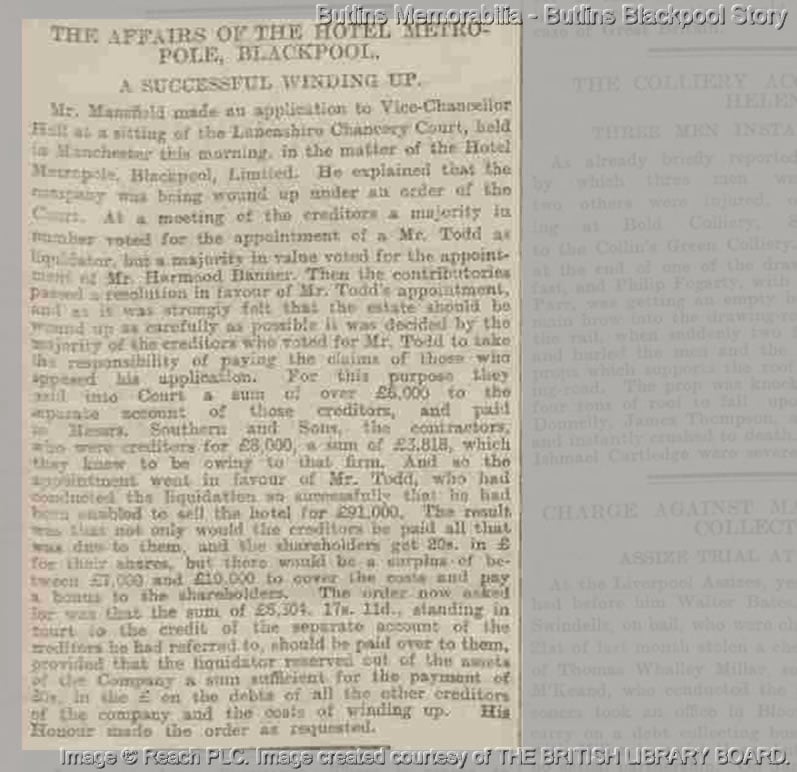
On Tuesday, February 21, 1899, Mr Mansfield submitted an application to Vice-Chancellor Hall at the Lancashire Chancery Court to facilitate the winding up of Metropole Blackpool Limited. The discussion would encompass the specifics regarding the official liquidator, Mr. Todd , "estate should be wound up as carefully as possible". As reported in the Manchester Evening News, over £6,000 was paid to the court to settle the matter;
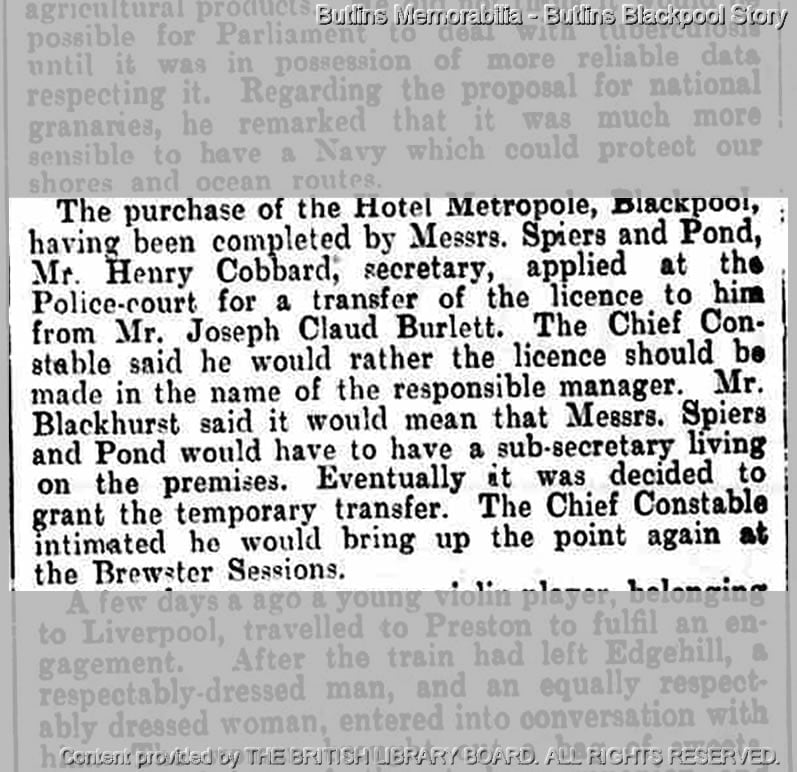
With all outstanding debts settled, the liquidation was deemed successful under Mr. Todd's leadership. This process was regarded as highly successful since Mr Todd had finalised the sale of the hotel to the new owners, Spiers and Pond Limited, for £91,000. This information brought great satisfaction to many, as creditors were set to receive their payments, and shareholders were also to benefit from the proceeds of the hotel sale. Shareholders were to receive 20s in the pound for their shares, along with a bonus from the surplus ranging from £7,000 to £10,000 (which also accounted for costs). Application was submitted to transfer the license of the hotel to Mr Henry Cobbard from the former ownership under Mr Joseph Claud Burlett.
Image found at the British Newspaper Archive website - Link
Showing details about the new owners of the Metropole Hotel - Blackpool.
Image found at the British Newspaper Archive website - Link
Showing the liquidation requirements are fulfilled.
The Metropole Hotel is looking towards a promising future as the new owners prepare to outline their plans for this historic venue. However, the former owners are now facing another challenge, as the debenture holders (the plaintiffs) have requested the ordinary debenture decree along with costs, given that the proceeds from the sale could easily fulfil this payment. Mr Maberly and Mr Tipping represented the plaintiffs, while the defendants, the liquidators, were represented by Mr Mansfield and Mr Cunliffe. Mr Mansfield noted that the liquidator had offered the plaintiffs a sum greater than what they were entitled to, which they subsequently rejected.
The reason for adding this part of history as we see that the Honour would explain more about the debenture holders position and a part of the history of the hotel leading to this moment; "The company got into difficulties, and the security was endangered, and thereupon this action was begun by the plaintiff in May, 1898, on behalf of himself and all other debenture holders, and a receiver and manager was appointed on the their behalf. After that, in June, an order was made by the court for the winding up of the company property, and it being very desirable that the sale should be carried out an order was made by which the debenture holders and their trustees released all claim against the property upon payment into court of £25,000, a sum amply sufficient to cover what should be found due to them on taking the accounts. That release by the trustees was a concession on their part. The action then went on for the purpose of ascertaining who was entitled to the debentures, and how much was due to each person. It was quite true that a mortgagor was entitled at any time to stop an action brought for the realisation of the security on payment of principal, interest, and cost of the action. What had been done here was that certain offers were made by the liquidator to the solicitors of the plaintiff, but the plaintiff not knowing who the other debentures holders were could not bind himself by accepting any sum in discharge of the property, and having begun an action of this kind he was bound to go on with it for the purpose of finding out who the persons entitled were and how much was due to each" This information was found from a newspaper article from the Manchester Courier in March 1899, and it shows that there was a concern during the final years of the hotel under the ownership at the time. This small additional story adds to the history of the hotel and its meaning as we continue the story of the hotel under the ownership of Spiers and Pond Limited. (You can read more about this subject on the Liverpool Mercury, October 1899, via this link and the Liverpool Shipping Telegraph and Daily Commercial advertiser, 23rd November 1899 via this link)
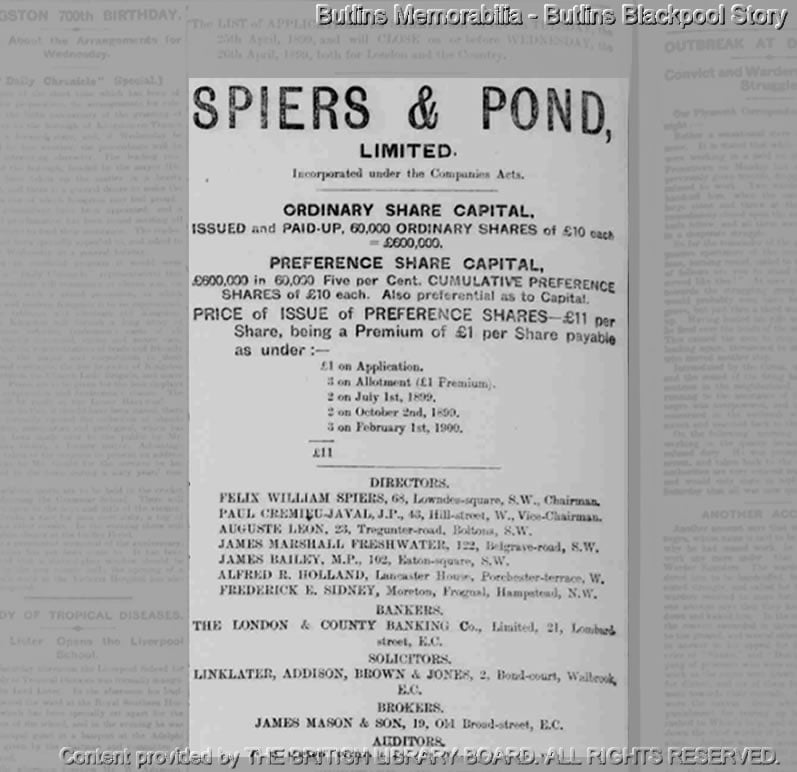
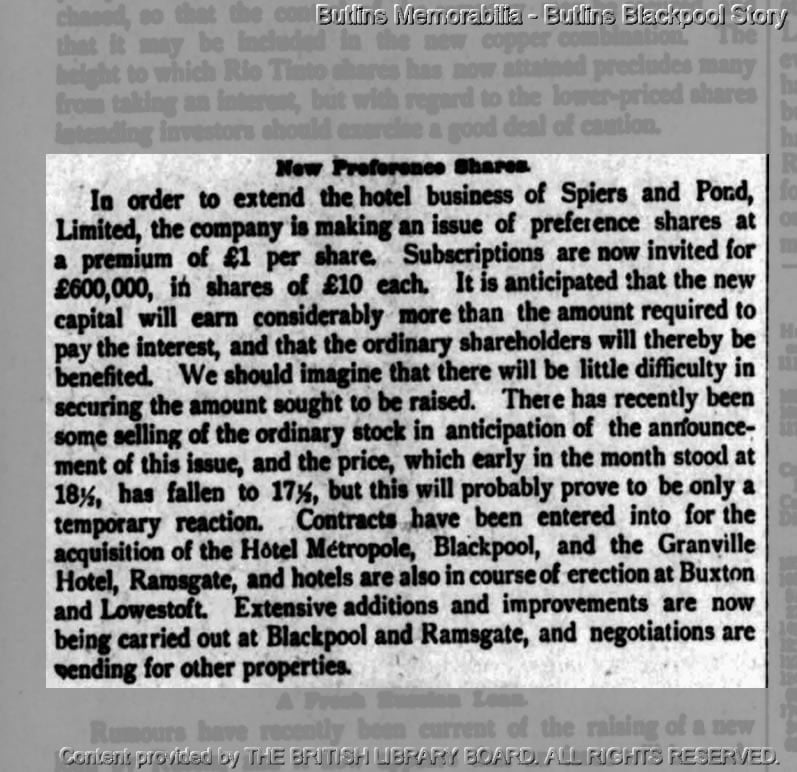
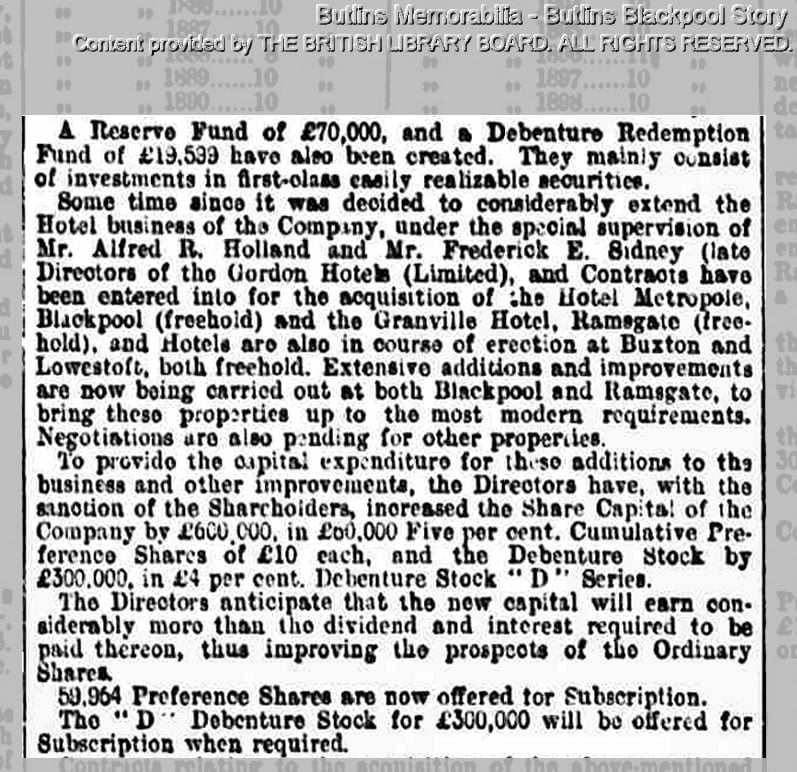
The Spiers and Pond Limited company had purchased two hotels, the Metropole Hotel in Blackpool (freehold) and the Granville Hotel in Ramsgate. An article explains that "Extensive additions and improvements are now being carried out at both Blackpool and Ramsgate, to bring these properties up to the most modern requirements". The new owners would issue preference shares at the premium of £1 per share, with subscriptions now invited for £600.000 in shares of £10 each. The improvement program would be supervised by Mr Alfred R Holland and Mr Frederick E Sidney (who was the late director of the Gordon Hotels Limited.
Image found at the British Newspaper Archive website - Link
In this newspaper article, you can see more information about the improvements planned.
Image found at the British Newspaper Archive website - Link
Additional information about the improvement program in place for the improvement of the hotels that they have purchased recently.
Image found at the British Newspaper Archive website - Link
Confirming the names of those involved in the development.
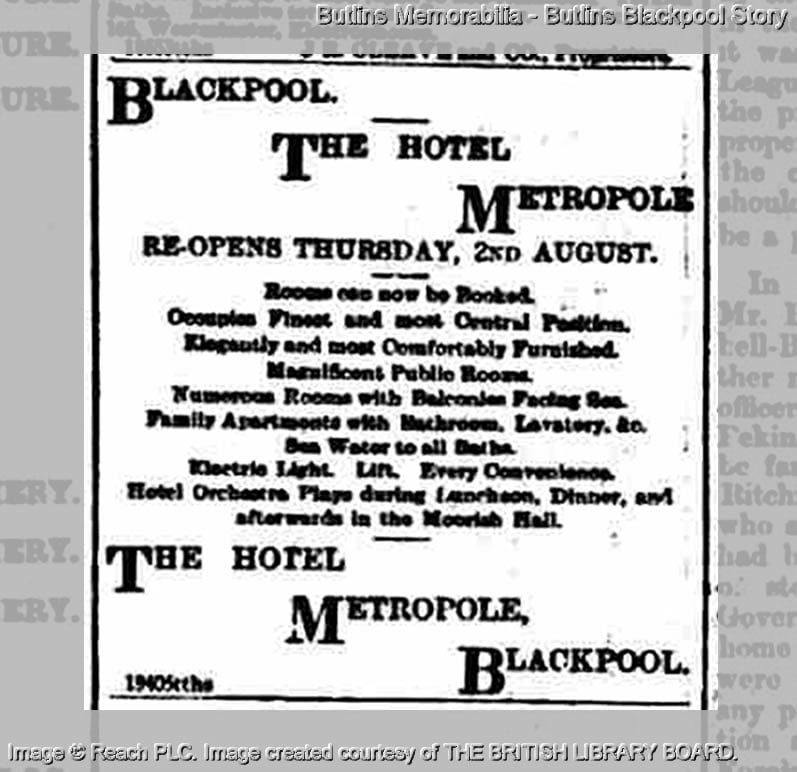
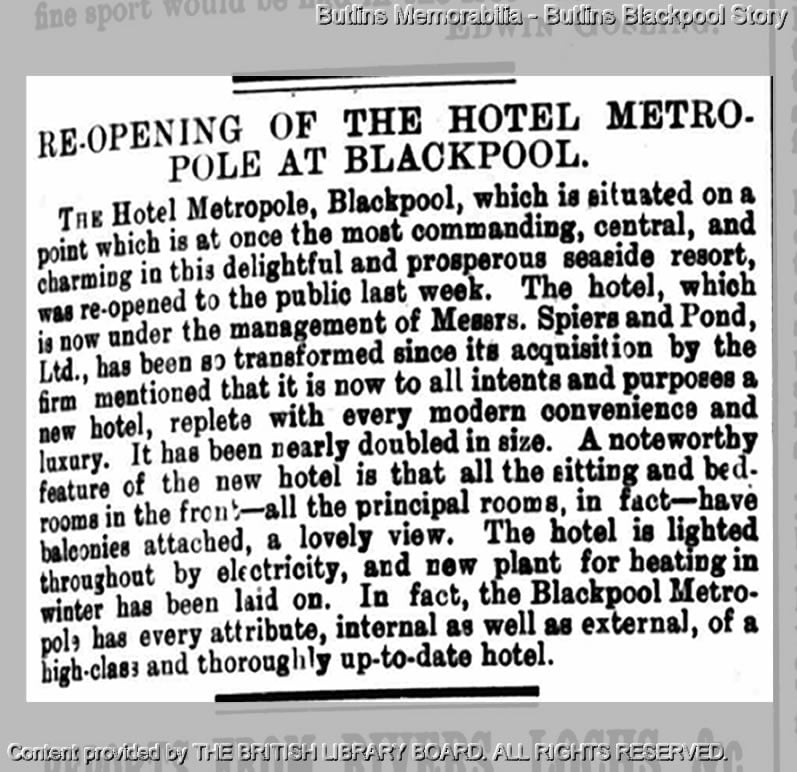
As we move from the 1800s to the 1900s, we see the story of the Metropole Hotel change once again as the new owners, the Spiers and Pond Limited, start to invest in improvements. An advertisement in the Fishing Gazette dated August 11, 1900, reveals that the Metropole Hotel has now doubled in size, featuring new amenities such as sitting and bedrooms at the front, along with principal rooms that have balconies offering a beautiful view. The article also boasts about the installation of electricity throughout the hotel, with a new plant set up for heating during the winter months. Advertisements from the new owners began to appear in newspapers, showcasing the offerings at the Metropole and other affiliated hotels. The Spiers and Pond Limited wanted the Blackpool Hotel to be open by the 2nd August to welcome guests once more.
Image found at the British Newspaper Archive website - Link
Advertisement showing the Metropole Hotel reopening on the 2nd August 1900.
Image found at the British Newspaper Archive website - Link
Explaining the new changes to the hotel as it reopens.
Image found at the British Newspaper Archive website - Link
Advertisement showing the Blackpool Hotel after opening for the first time under the new owners.
A special event was hosted at the Metropole Hotel on the 19th and 20th of September for the Macbeths, of King Street autumn fashions. This event would include
Inspections via invitations was requested for this event. (source)
Image found at the British Newspaper Archive website - Link
A change to the advertisements in 1905
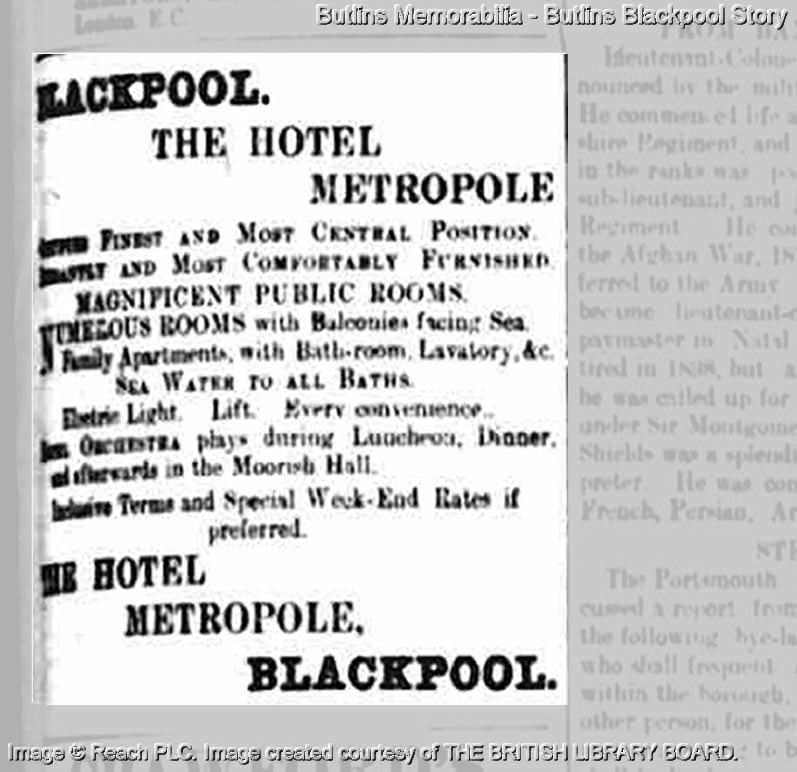
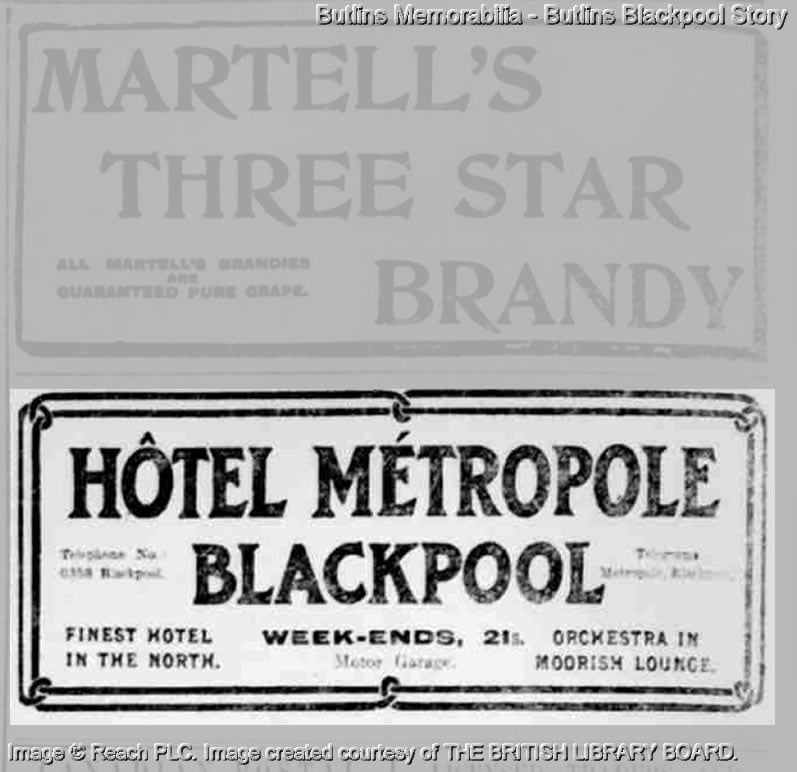
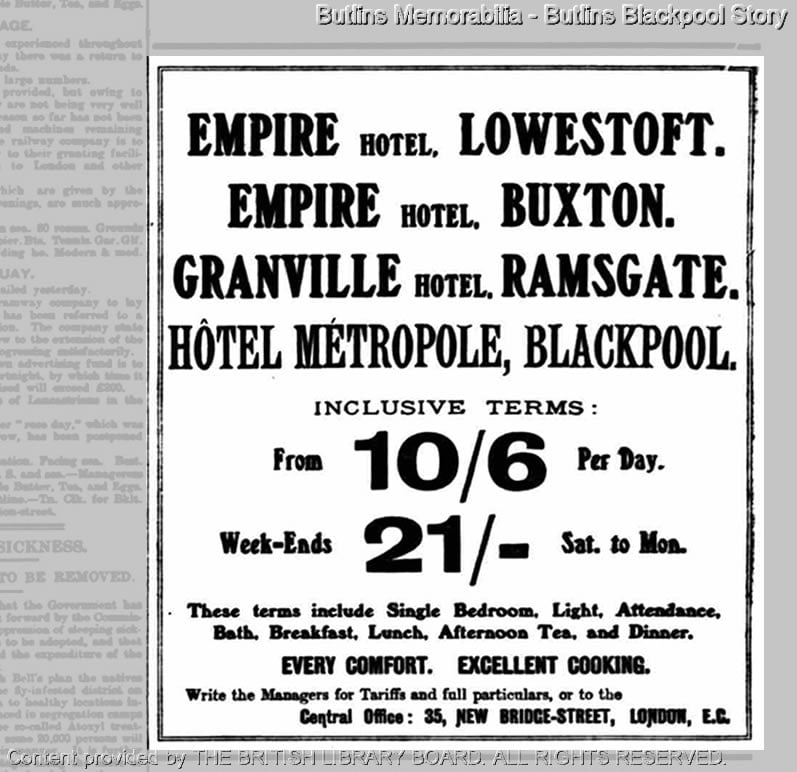
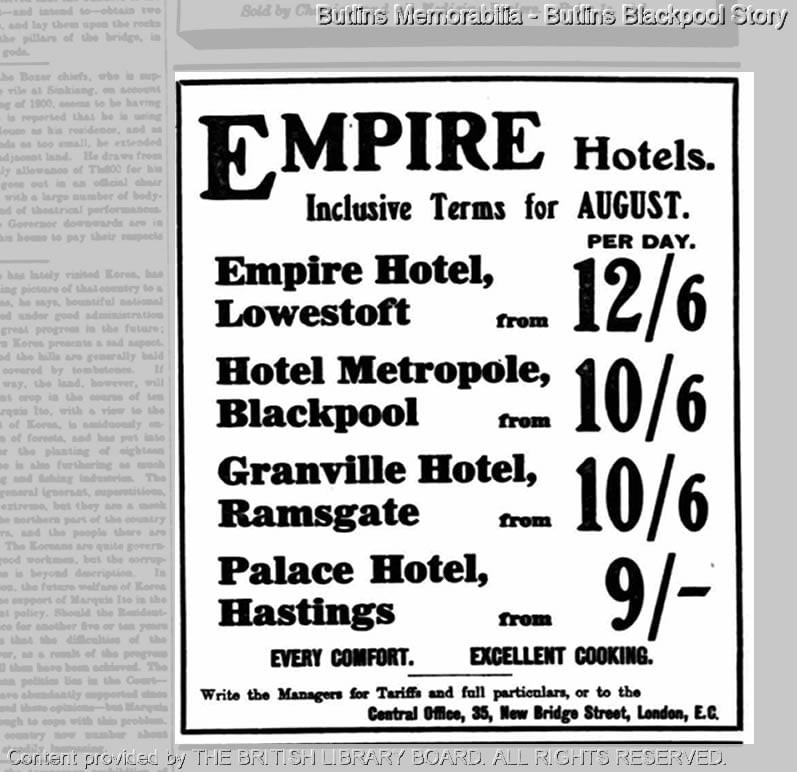
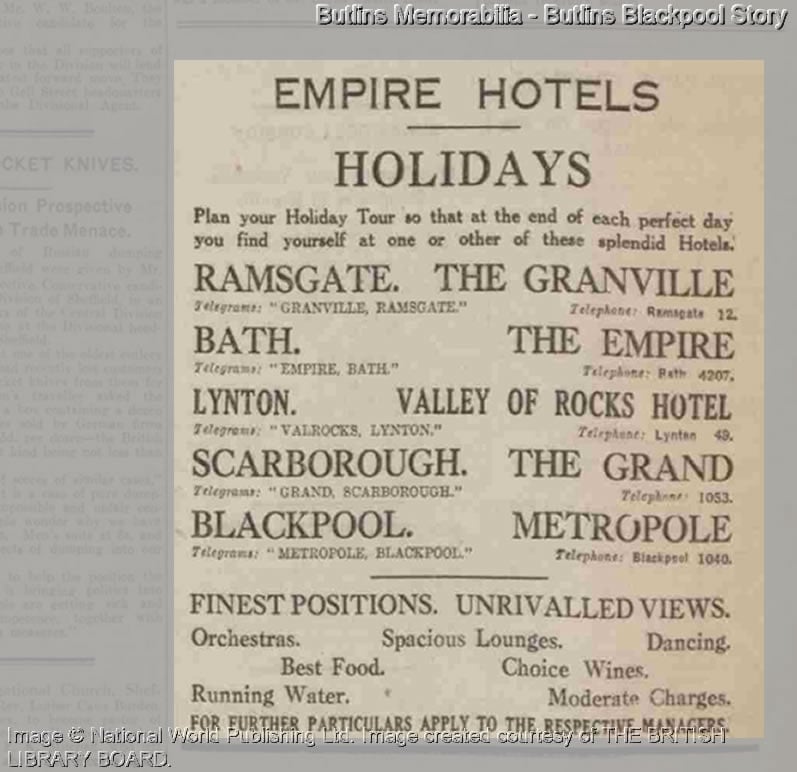
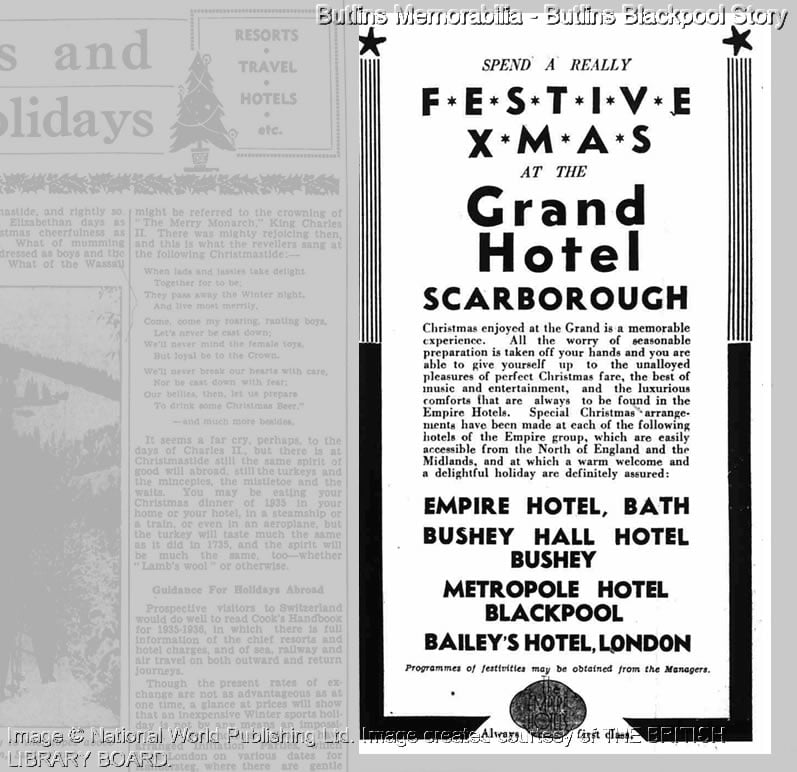
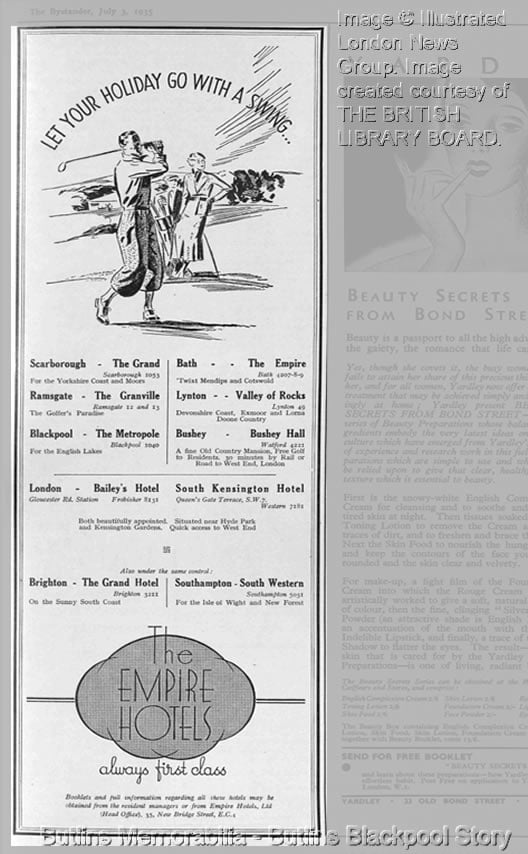
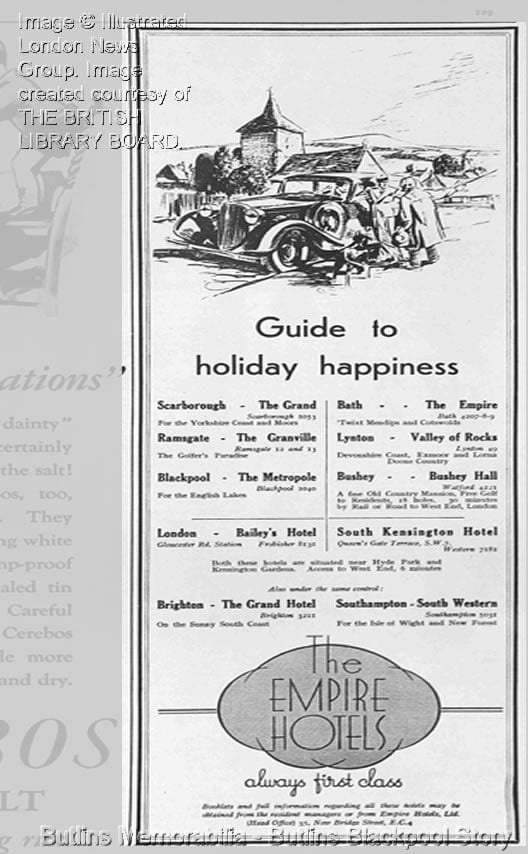
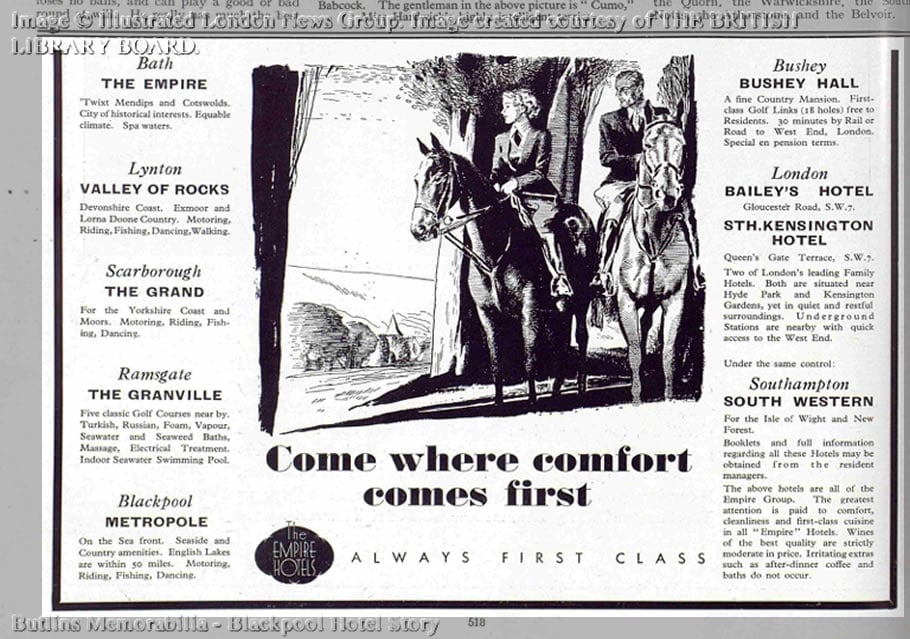
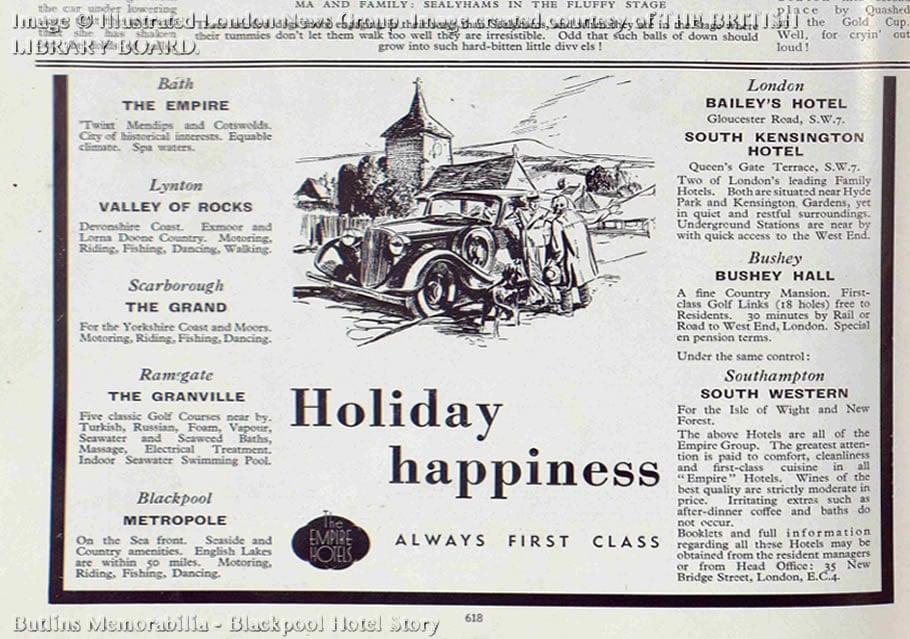
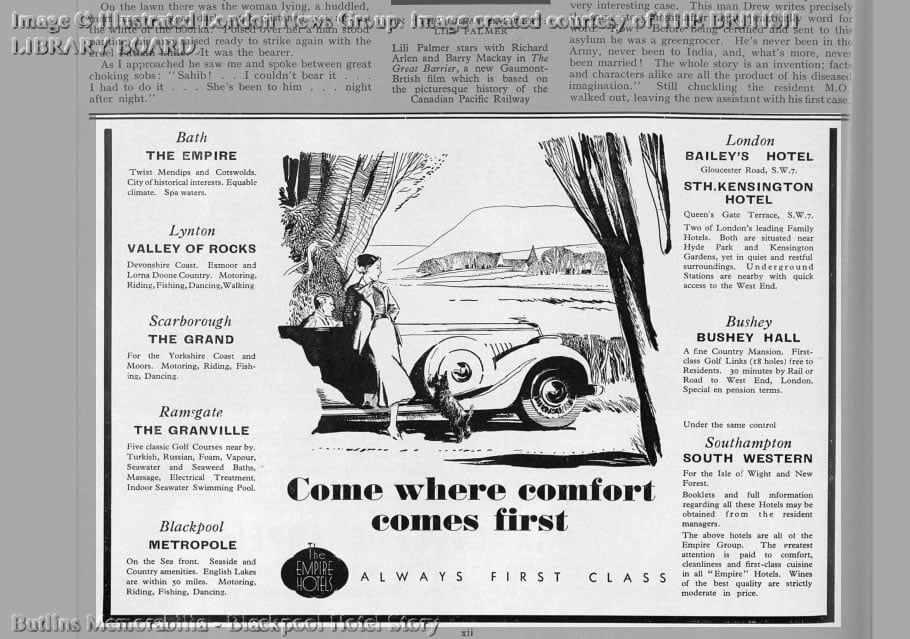
In 1907, research findings demonstrated that the Metropole Hotel had again changed ownership and was now under the management of the Empire Hotels company. An advertisement in the Daily Telegraph & Courier indicated that the hotels were being promoted under the Empire Hotels brand. I have not been able to uncover any further details regarding the timing of this ownership change, but the advertisements from this year onward consistently feature the Empire Hotels name or logo.
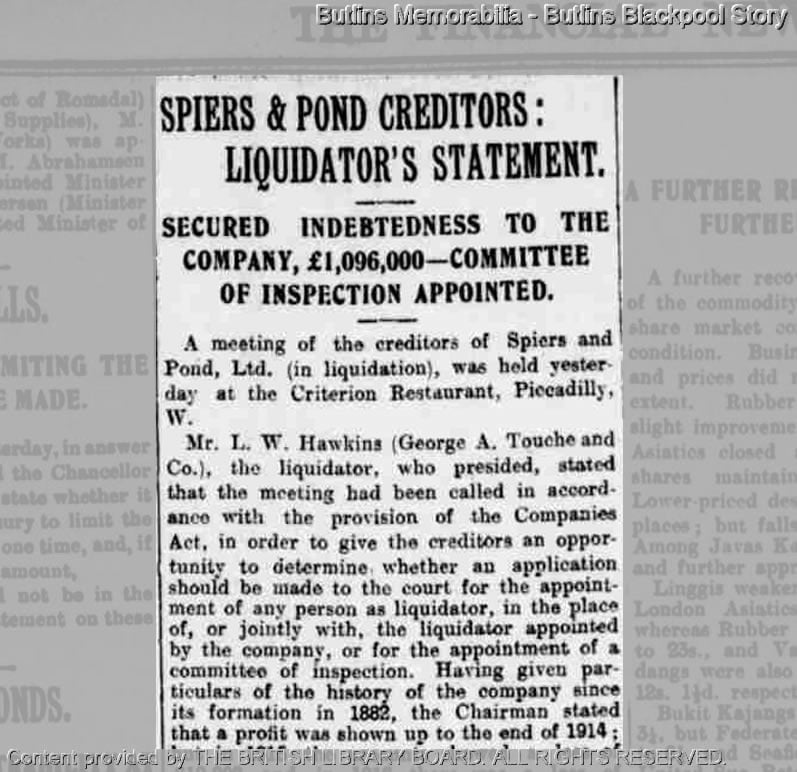
In 1916, it was reported that Spiers and Pond Ltd, the parent company, was undergoing liquidation. The official liquidator was Mr L. W. Hawkins from George A. Touche and Co., who convened a meeting at the Criterion Restaurant in Piccadilly in compliance with the Companies Act. The purpose of the meeting was to review the company's history from its formation in 1882 until 1914, noting that 1915 had recorded a significant loss of £19,806 and a further loss of £14,236 in 1916. These financial setbacks had severely affected the creditors and shareholders, necessitating a review of the liquidation process and the appointment of a company or individual to act as liquidator. The meeting highlighted a trend of substantial decline in business over the six years leading up to 1916, with the losses in 1915 and 1916 making it increasingly challenging for the company to maintain its services. Coupled with the added burden of necessary changes and improvements, the losses were too significant for the company to pursue its intended path, thus fulfilling the conditions required to initiate the liquidation process. Mr H. F. Kemp was designated as the interim receiver and manager on behalf of the debenture holders, starting June 30th.
During the meeting held on July 11, 1905, it was decided in a discussion with the shareholders that a voluntary liquidation would commence, and Mr Hawkins was appointed as the liquidator. Notably, Mr Hawkins felt that liquidation was not the appropriate course of action and believed there were alternative options to pursue. However, since his suggestion was not taken into account, the liquidation process would proceed. Upon reviewing the accounts, it was determined that the company's assets totalled £1,863,373, although certain items were exceptions, reducing the value to £1,705,393. Mr Hawkins also discovered that there were around 2,000 creditors to consider in this process, with claims ranging between £75,000 and £80,000, alongside preferential shares amounting to £26,000.
There was considerable apprehension among the shareholders and creditors concerning the secured debt, which reached £1,096,000. This obligation must be fulfilled before any dividends can be paid to the unsecured creditors. Given that the assets were valued at £1,705,393 and the secured claims totalled £1,096,000, Mr Hawkins would have a remaining surplus of £609,393, although this is contingent upon certain terms and conditions, such as the costs associated with receivership and the interest accruing on the debentures and debenture stocks. The general consensus was that the outgoings were leading to a scenario where no money would be available for the creditors and shareholders, presenting Mr Hawkins with a significant task to manage.
You can read a brief history of the Spiers & Pond story by clicking on these words
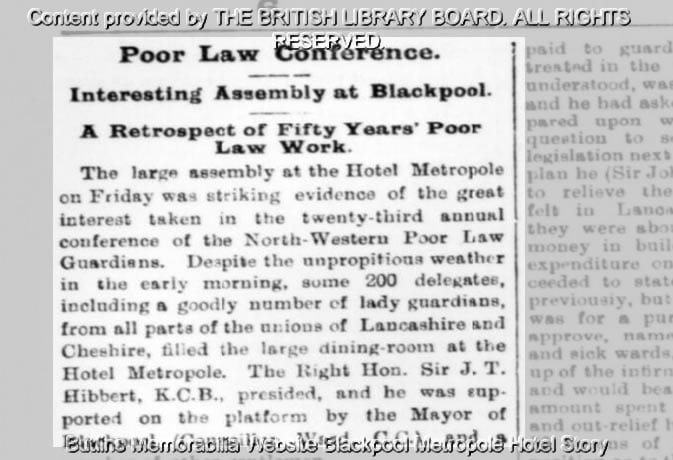
Image found at the British Newspaper Archive website - Link
Article confirming that the Spiers & Ponds was going into liquidation, which made the security of the hotel in question once again.
Image found at the British Newspaper Archive website - Link
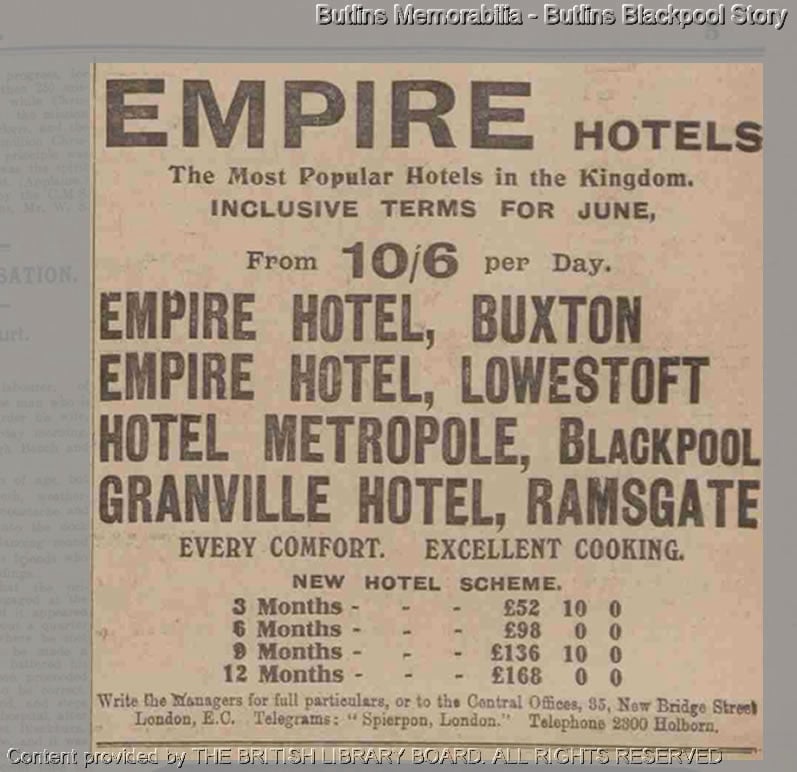
Showing the rates at the hotels under the Empire Hotels group.
Image found at the British Newspaper Archive website - Link
Showing the rates at the hotels under the Empire Hotels group.
Image found at the British Newspaper Archive website - Link
Showing the rates at the hotels under the Empire Hotels group.
Image found at the British Newspaper Archive website - Link
This advertisement has a term called "New Hotel Scheme" which I am unsure what its about but still interesting to see.
Image found at the British Newspaper Archive website - Link
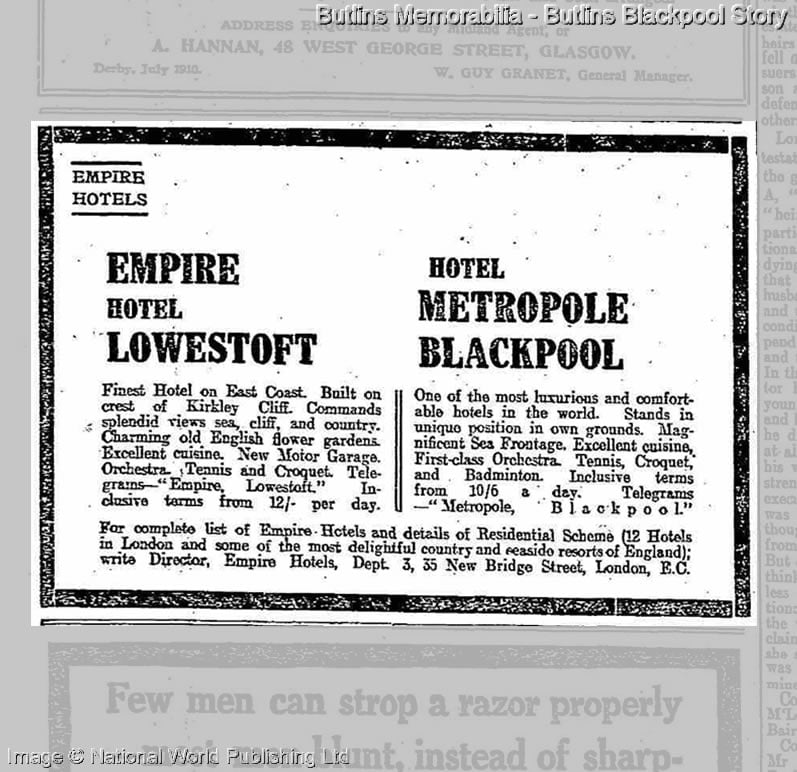
Featuring the Metropole Hotel in Blackpool alongside the Empire Hotel in Lowestoft.
Special events held at the Metropole Hotel in Blackpool from 1910 - 1919;
Image found at the British Newspaper Archive website - Link
Special events held at the Metropole Hotel in Blackpool from 1930 - 1939;
Image found at the British Newspaper Archive website - Link
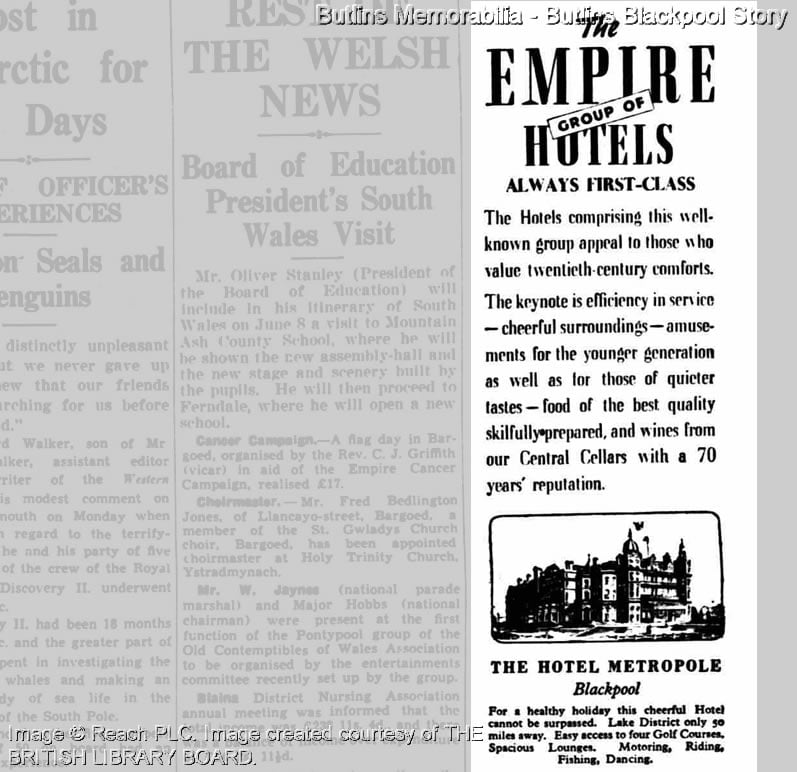
Advertisement featuring the Empire Hotels
Image found at the British Newspaper Archive website - Link
This advertisement is showing the Empire Hotel logo.
Image found at the British Newspaper Archive website - Link
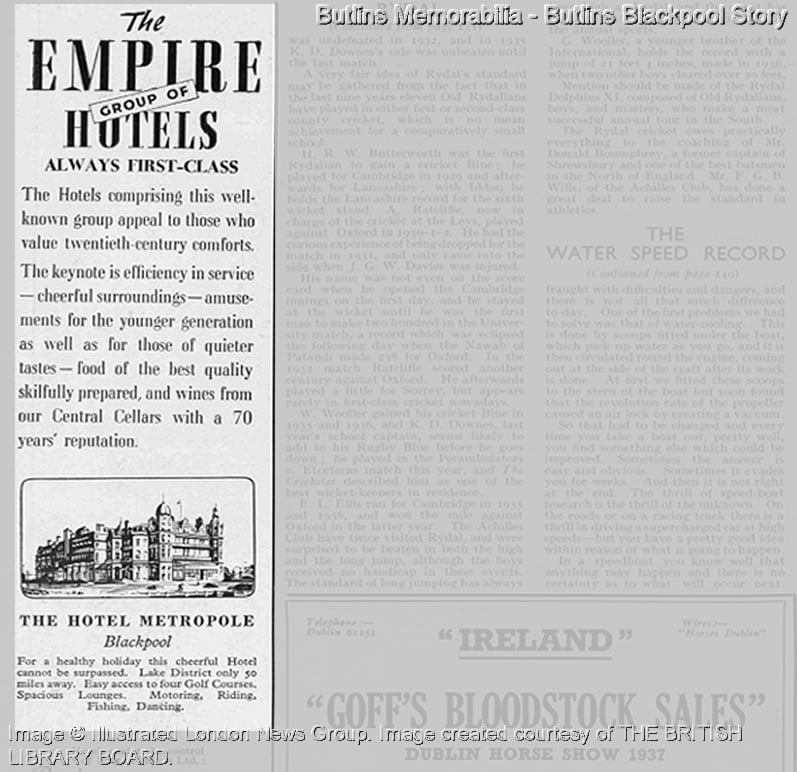
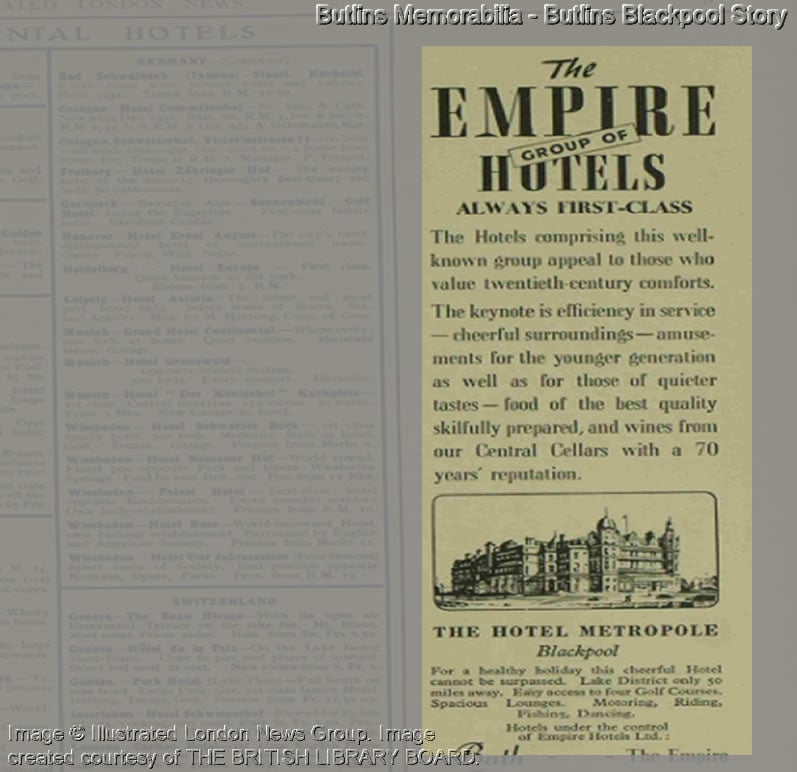
An excellent advertisement featuring the Blackpool Hotel under the Empire Hotels group.
Image found at the British Newspaper Archive website - Link
An excellent advertisement featuring the Blackpool Hotel under the Empire Hotels group.
Image found at the British Newspaper Archive website - Link
An Empire Hotel advertisement showing the Blackpool Hotel in this story.
Image found at the British Newspaper Archive website - Link
An Empire Hotel advertisement showing the Blackpool Hotel in this story.
Image found at the British Newspaper Archive website - Link
An Empire Hotel advertisement in the year that Butlins opened featuring the future Butlins Blackpool hotel.
Image found at the British Newspaper Archive website - Link
Showing a photo of the hotel that many people will recognise under the Empire Hotels company.
Image found at the British Newspaper Archive website - Link
Showing a photo of the hotel that many people will recognise under the Empire Hotels company.
Image found at the British Newspaper Archive website - Link
Showing a photo of the hotel that many people will recognise under the Empire Hotels company.
Image found at the British Newspaper Archive website - Link
A review of the Metropole Hotel under the management of the Empire Hotels. It also explains that the hotel has just been redecorated.
Image found at the British Newspaper Archive website - Link
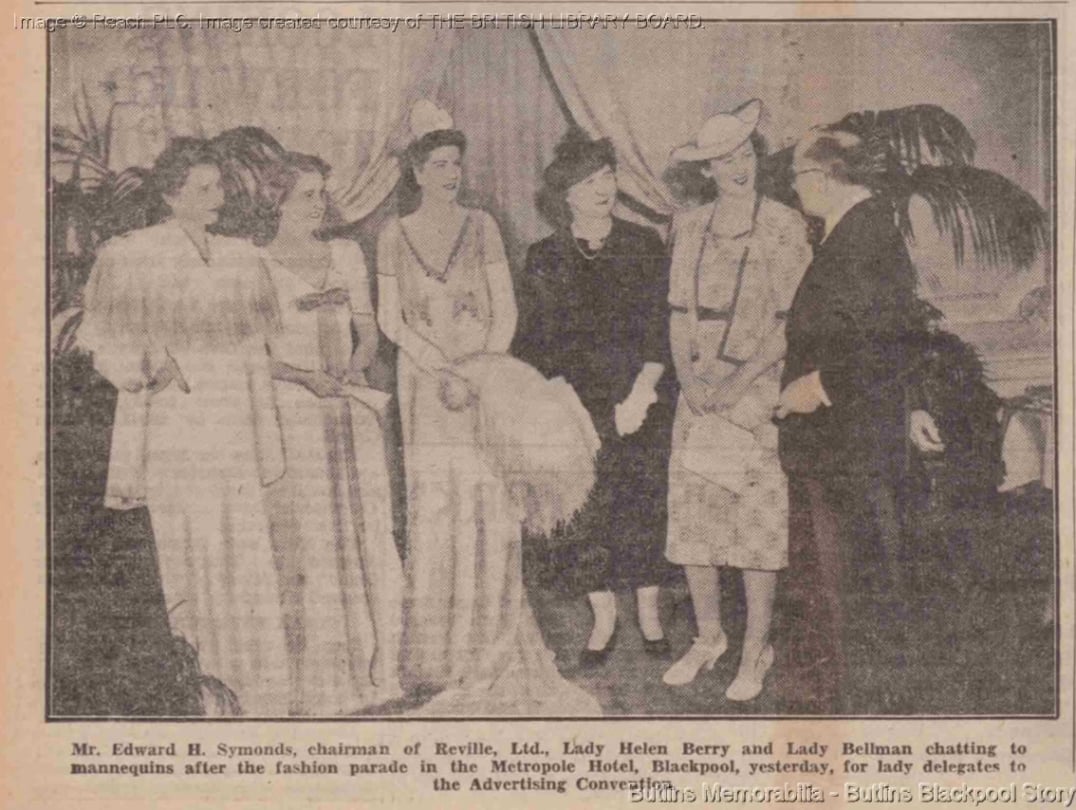
An excellent photo of the Fashion Parade, hosted at the Metropole Hotel in 1939. This photo offers a glimpse of the hotel during these years.
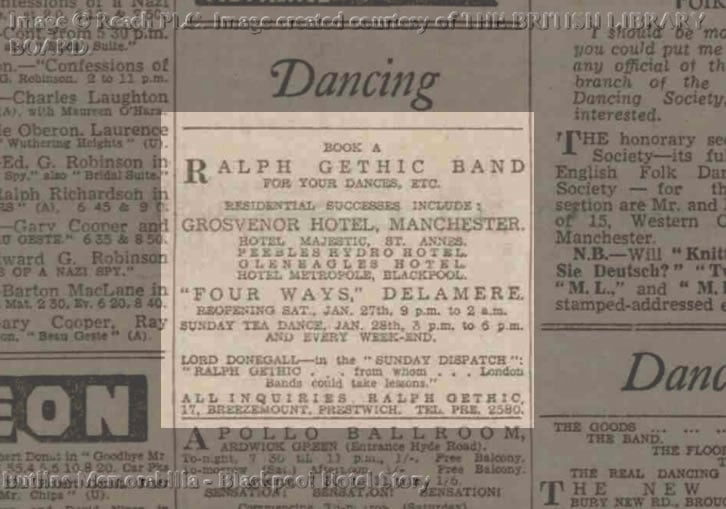
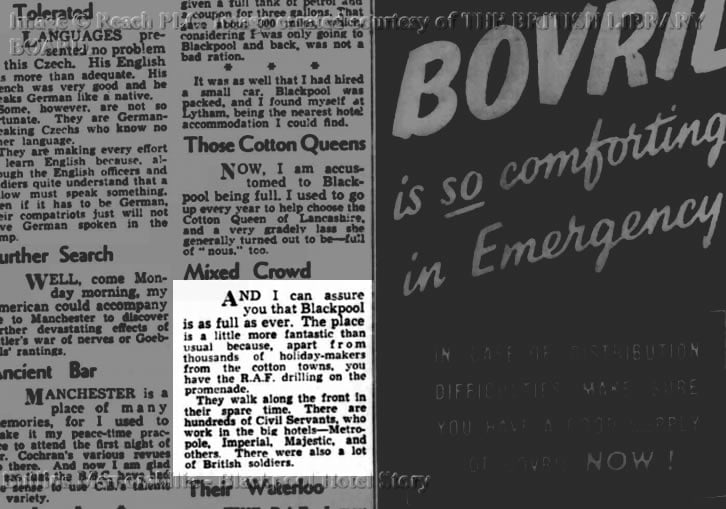
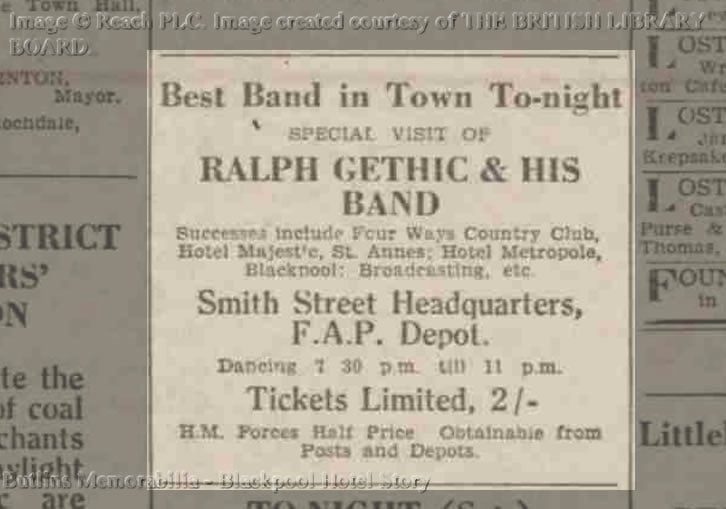
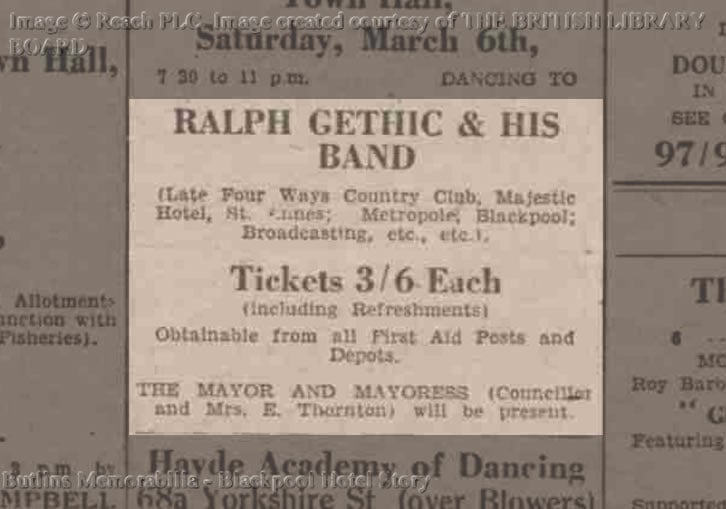
An additional significant historical event was noted in the diary when, in 1939, it was declared that the United Kingdom was at war, which we now know as World War 2. As part of the war strategy, the Blackpool Metropole Hotel was requisitioned for war support. The Empire Hotel group's advertisements would stop immediately as I searched for further information during these crucial years. Here is the information I found regarding the Metropole Hotel during the war that was publicly advertised.
Image found at the British Newspaper Archive website - Link
Manchester Evening News - Friday 19 January 1940
An advertisement showing dancing with the Ralph Gethic Band was still available in the hotel.
Image found at the British Newspaper Archive website - Link
Weekly Dispatch (London) - Sunday 04 August 1940
Giving us insight to what it was like during the War.
Image found at the British Newspaper Archive website - Link
Rochdale Observer - Saturday 28 November 1942
Take note of the bottom part of this advertisement which states "H.M. Forces half price"
Image found at the British Newspaper Archive website - Link
Rochdale Observer - Saturday 20 February 1943
The Raplh Gethic & His band returns back to the hotel with the Mayor and Mayoress (Councillor and Mrs E. Thornton attending this event.
Image found at the British Newspaper Archive website - Link
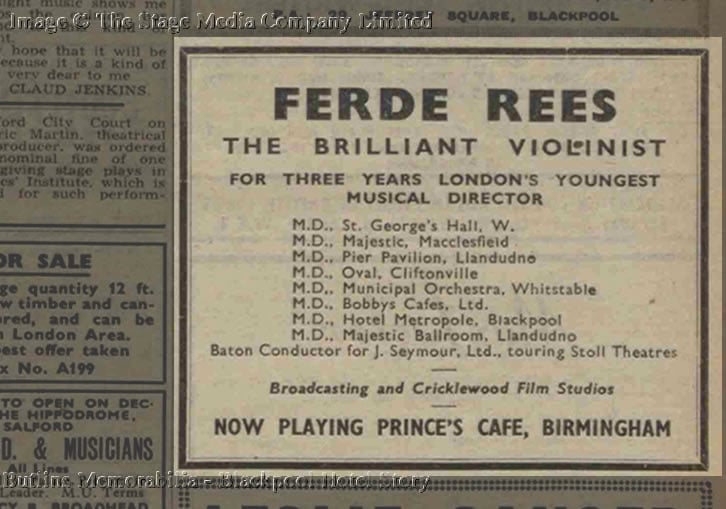
The Stage - Thursday 09 December 1943
Another special event hosted at the Metropole Hotel with Ferde Ress, a violinist.
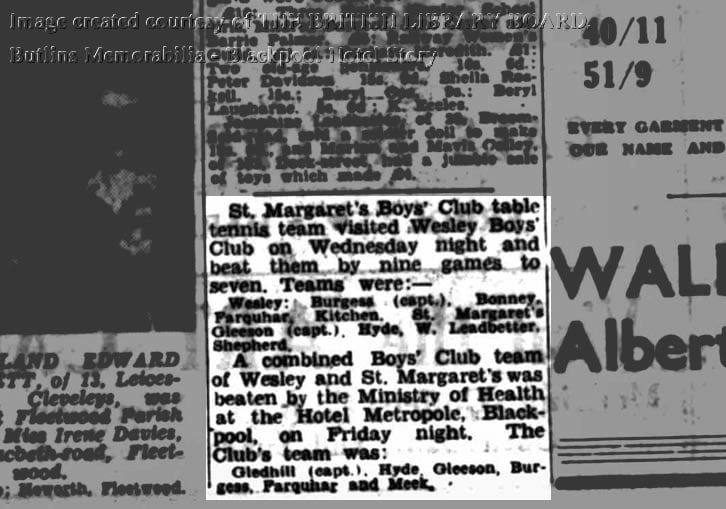
Image found at the British Newspaper Archive website - Link
Fleetwood Chronicle - Friday 12 May 1944
An interesting article where we see a bit of competition with the Ministry of Health at the Metropole Hotel in Blackpool
Image found at the British Newspaper Archive website - Link
Blyth News - Monday 09 April 1945
Another interesting story related to the use of the hotel.
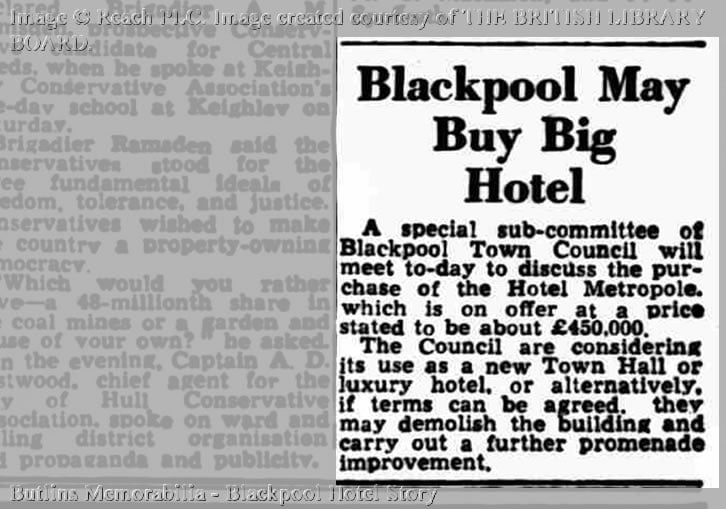
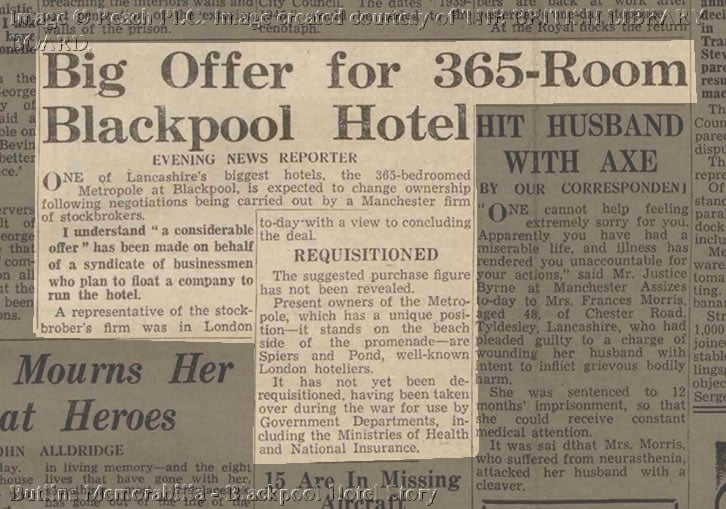
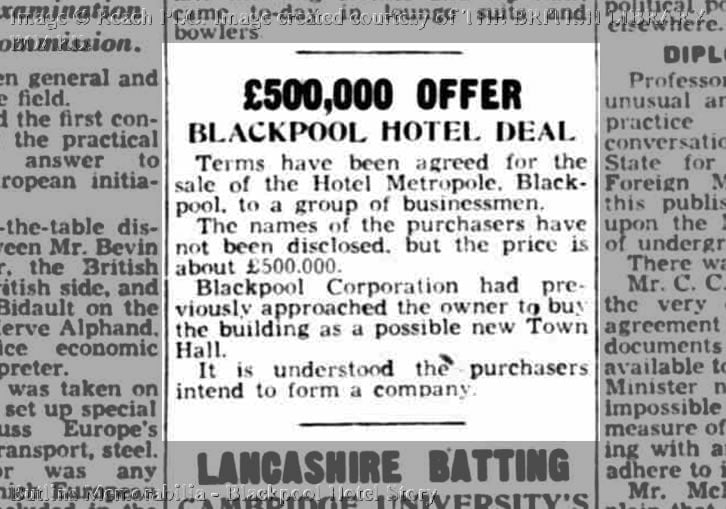
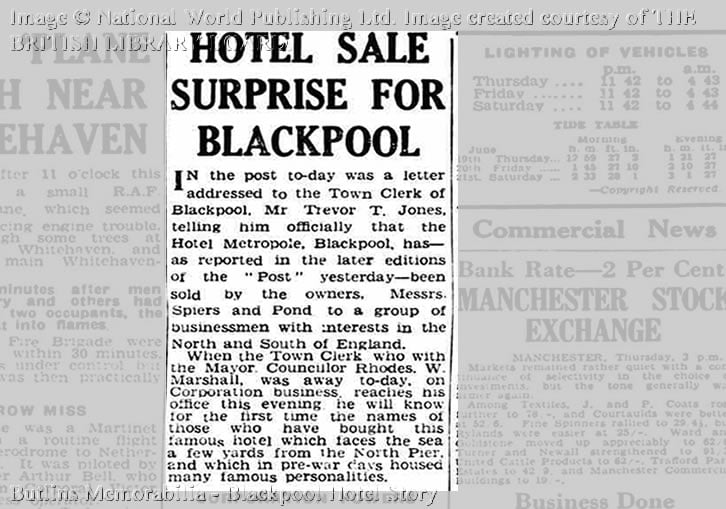
Once World War II came to a close, people across the globe began the challenging endeavour of restoring normal life. The Metropole Hotel would remain under government control until 1947, when an offer was made to purchase the hotel when it was de-requisitioned. An agreement was reached at £500,000 from a group of businessmen, whose names were not known at that time. There was also a previous proposal from the Blackpool Corporation, which intended to use the building as the new town hall, but this offer was not accepted. It is interesting to note that while the Empire Hotels were advertising their hotels, the Manchester Evening News in 1947 indicated that the owners were still Spiers and Pond, which might suggest that the hotel was owned by them but leased to another party or a new subdivision of the parent company.
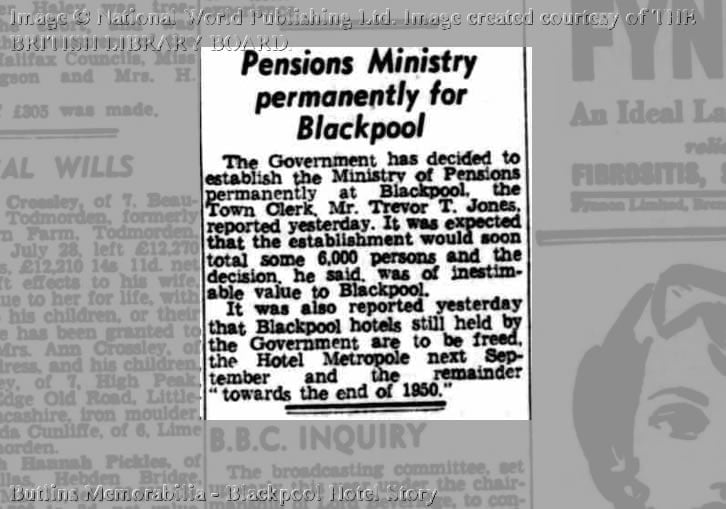
As I continued my investigation into the hotel’s history after the war, I was surprised to discover a lack of advertisements indicating its status until I found an article in the Halifax Evening Courier from Wednesday, October 12, 1949. This article informed us that the government was still managing the hotel, despite a purchase offer made in 1947. It stated, "....it was also reported yesterday (Tuesday the 11th October 1949) that Blackpool Hotels still held by the government are to be freed, the Hotel Metropole next September and the remainder towards the end of 1950". This certainly explains why I was unable to find any information regarding the hotel’s story, as it was still under government control at that time.
Image found at the British Newspaper Archive website - Link
Details regarding the hotel potentially being transformed into the new town hall, a luxury hotel, or possibly facing demolition.
Image found at the British Newspaper Archive website - Link
Showing an offer for the hotel and additional information.
Image found at the British Newspaper Archive website - Link
Showing details about the offer being made to purchase the hotel back from the government.
Image found at the British Newspaper Archive website - Link
Excellent newspaper article showing further details about the sale.
Image found at the British Newspaper Archive website - Link
An interesting note for the history books in this newspaper article.
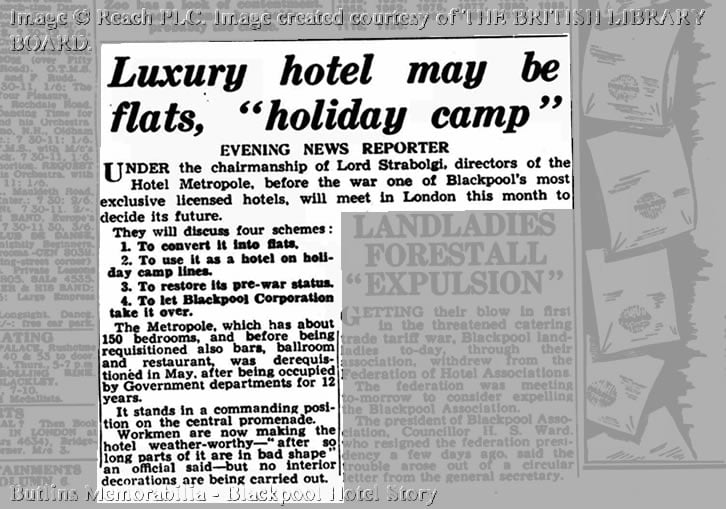
In the Manchester Evening News on Wednesday, July 11, 1951, an article revealed that the hotel's future was still undecided, despite an offer made in 1947. It stated that the hotel was in the process of being made weatherproof, as it was in poor condition. The article suggested that the site was being considered as one of four options: 1. Converting it into flats, 2. Using it as a hotel on holiday camp lines, 3. Restoring the hotel to its pre-war status, and finally, 4. Granting permission to the Blackpool corporation to take it over. A meeting, chaired by Lord Strabolgi, who had been a director of the hotel before the war, would discuss the hotel's future in London.
Image found at the British Newspaper Archive website - Link
This highlights that the hotel was still in the process of being repaired, with a lot of work left to do and its future to be assessed as we move towards the Butlins Story.
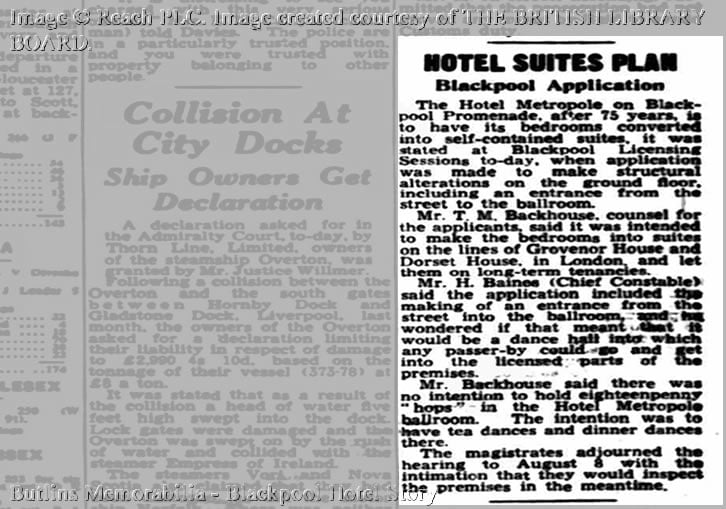
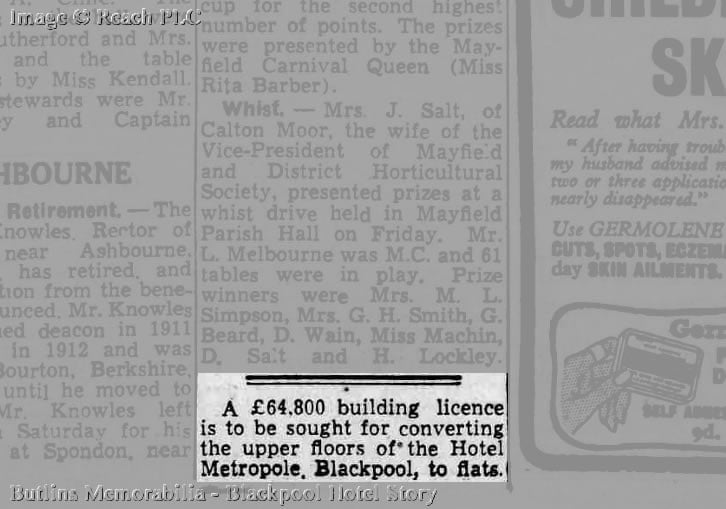
In 1952, the Liverpool Echo reported that the hotel was set to undergo further modifications, converting bedrooms into self-contained suites and making structural changes to the ground floor. The new plans also involved alterations to the entrance from the street leading to the ballroom. A gentleman named Mr T. M. Backhouse stated that the intention was to transform the bedrooms into suites similar to those at the Grosvenor House and Dorset House in London, intending to rent them out on long-term leases. At the time of this article, published on Monday, July 28, 1952, no decision had been made to proceed with these plans. On November 14, 1952, the Staffordshire Sentinel reported that an application had been submitted to convert the upper floors of the hotel into flats at a cost of £64,800.
Image found at the British Newspaper Archive website - Link
Showing plans to make some changes to this historic hotel.
Image found at the British Newspaper Archive website - Link
Plans submitted for converting into flats in 1952.
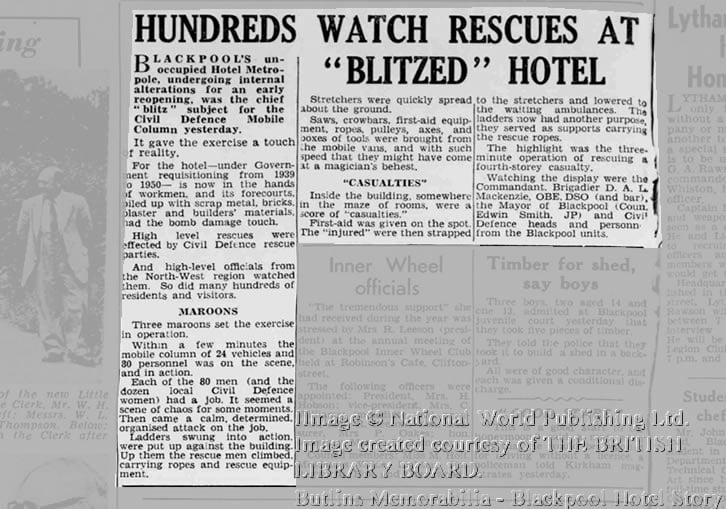
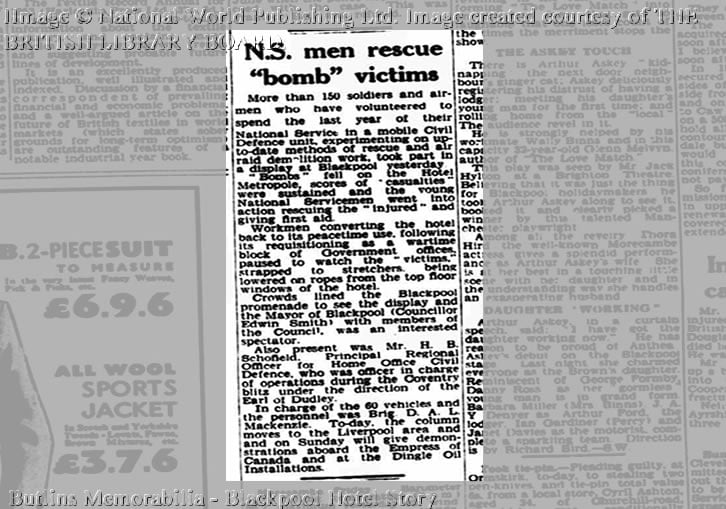
An article of interest appeared in the West Lancashire Evening Gazette on Friday, June 19, 1953, regarding the hotel, headlined "Hundreds watch rescues at 'Blitzed' Hotel." The article explains that the hotel was unoccupied and undergoing renovations for its reopening when it became the focus of a Blitz scenario with the Civil Defence Mobile column. A training exercise was executed to simulate damage that resembled a bomb explosion at the hotel. The training experience involved high-level rescues, with officials from the North-West region and residents witnessing the events as they transpired.
This exercise was also highlighted in the Lancashire Evening Post on June 19, 1953, which detailed that 150 soldiers and airmen had volunteered to dedicate their final year of national service to the mobile civil defence unit. It further elaborated that the exercise aimed to train participants in modern rescue techniques and air raid demolition operations. Notably, it mentioned that workers at the site would pause their tasks to observe the exercise, and some victims were lowered on stretchers from the windows to the ground floor. After the exercise concluded at the Metropole Hotel, it was set to relocate to Liverpool and board the Empress of Canada. Those participating in this exercise were instructed to approach the event as if it were a real-life scenario and would include the following;
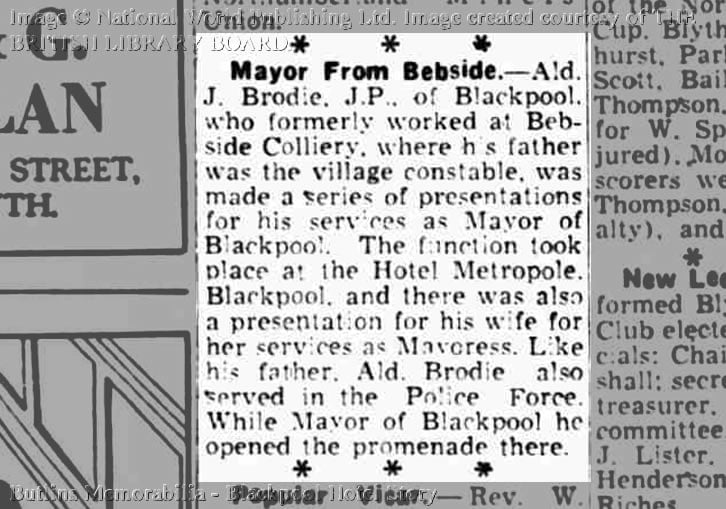
Observing this special exercise was Commandant, Brigadier D. A. L. Mackenzie (OBE, DSO and bar), the Mayor of Blackpool, Edwin Smith, JP , Mr H. B. Schofield (Principal Regional Officers for the Home office Civil defence (who was in charge) and the senior leaders of the Civil Defence and Personnel from the Blackpool units.
Image found at the British Newspaper Archive website - Link
Explaining the special exercise using the Metropole Hotel
Image found at the British Newspaper Archive website - Link
Further details on this special event.
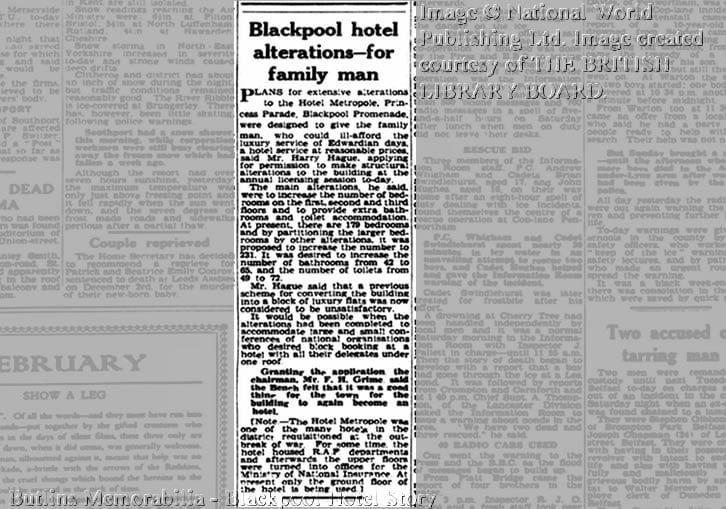
In the Lancashire Evening Post, a brief article indicated that there was yet another change in plans for this historic hotel. Titled "Blackpool Hotel Alterations - For Family Man," it clarifies that the proposal to convert the building into luxury flats was deemed "unsatisfactory." The submitted permission outlined a desire to make modifications to the hotel that would offer services at reasonable prices. Mr Harry Hague was the individual presenting this new vision for the hotel and stated that the plan would involve increasing the number of bedrooms on the first, second, and third floors, as well as providing additional bathrooms and toilets. Mr Hague explained that the hotel's current layout includes 179 bedrooms, and by partitioning the larger bedrooms and other spaces, they could increase the total number of rooms to 231.
The chairman, Mr. F. H. Grime, granted permission, stating that the building's return to use as a hotel would be advantageous for the town. It also verifies that during the war, the hotel served the RAF departments, with the upper floors repurposed as offices for the Ministry of National Insurance, and at the time of this publication, only the ground floor was operational.
On March 13, 1954, the Scotsman newspaper featured a brief announcement that Mr. Frank Hawtin had been appointed chairman of the Metropole Hotel (Blackpool) Ltd, succeeding Lord Strabolgi. For the first time since 1939, the Metropole Hotel in Blackpool was set to reopen. An advertisement in the Daily Express on Saturday, May 29, 1954, would display the message "Reconstructed & Refurnished throughout." The Royal Co-operative collecting society held a meeting at the hotel on September 29, 1954.
Image found at the British Newspaper Archive website - Link
Explaining the plans to change the Metropole Hotel to a hotel again and scrapping the flat plans.
Image found at the British Newspaper Archive website - Link
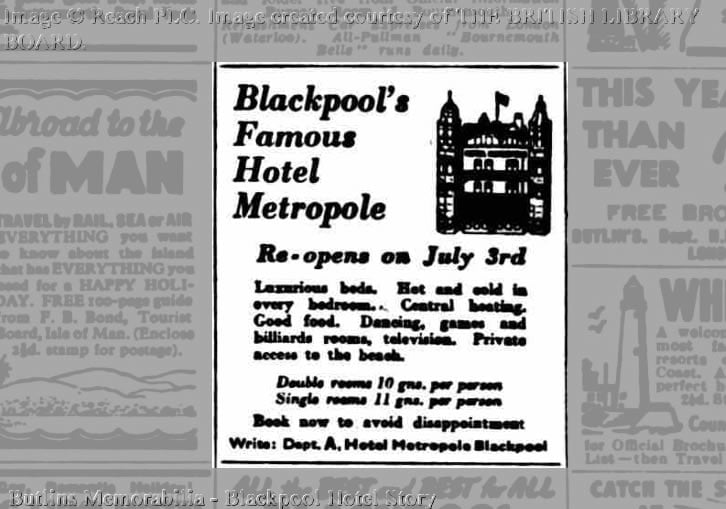
A new advert arrives in the newspaper advertising the hotel. This also confirms when it reopened, which was on the 3rd July 1954
Image found at the British Newspaper Archive website - Link
A new advert arrives in the newspaper advertising the hotel.
Chapter two of the Blackpool Metropole comes to an end as the Butlins era begins in chapter 3. I do hope you have found this page to be useful in your research and feel free to get in touch with me below....now click on chapter three and read my favorite era of the hotel.,