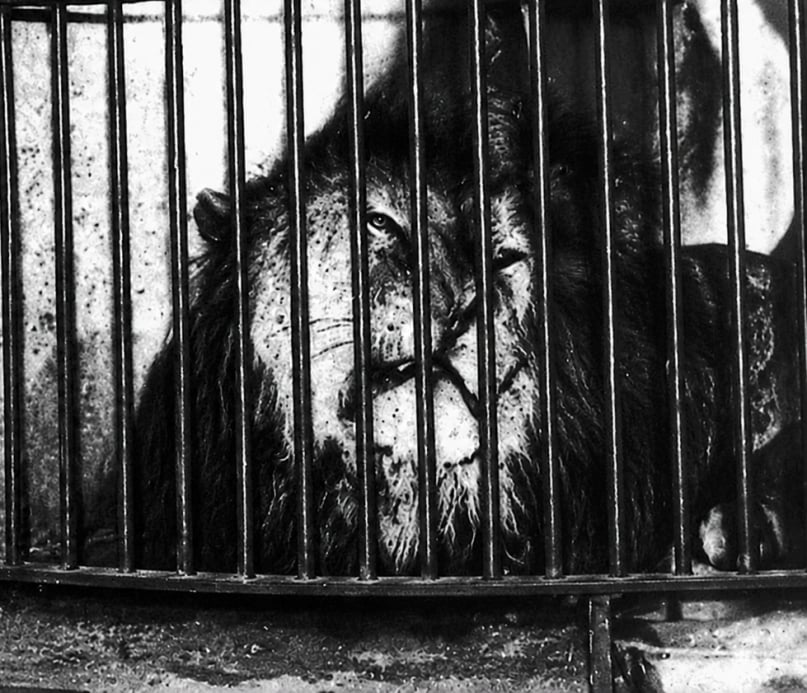
The story of Rex the Lion dates back to 1933, a time when he became famous for a story that never took place. You may be wondering, " What does that mean?" It all started in July of 1933, when Billy Butlin was preparing to open his new Butlins Bognor Regis zoo. Billy Butlin had requested that some animals from the Butlins Skegness zoo be transferred to their new home in Bognor Regis, which included his lion, known as Rex. At the Skegness zoo, the staff made arrangements for the safe transport of leopards, kangaroos, bears, and monkeys, ensuring that Rex the Lion was part of the group.
The lorry was set to embark on its lengthy trip to Sussex, arriving at the new Butlins Bognor Regis zoo, where the staff would assess the welfare of the animals and ensure everything was in order. During their inspection, they discovered that Rex was absent from the lorry and promptly notified Billy Butlin of their finding. Eager to verify the situation himself, Billy Butlin realised that his lion was indeed missing from the transport and intended to investigate the issue. However, before he could do so, a young journalist approached him for information regarding this incident. In response, Billy Butlin stated, "I don't know, I need to check." I believe at this stage of the story that someone had "tipped off" the journalist, or he just happened to be at the right place at the time.
For this young journalist, this was enough for him to conclude that the story needed to be published, as he sent his article off to the national newspapers in hopes of it being picked up. The story of Rex the Lion's escape would then start in the newspapers as Mr Proctor would send his findings to the national newspapers. Billy Butlin was concerned with his lion's health and that the local community is at the highest safety level at all times. In Billy Butlin style, he would be one of the people out in the town looking for his lion in the hope that Rex would be found.
Here is my research on how this story unfolds...
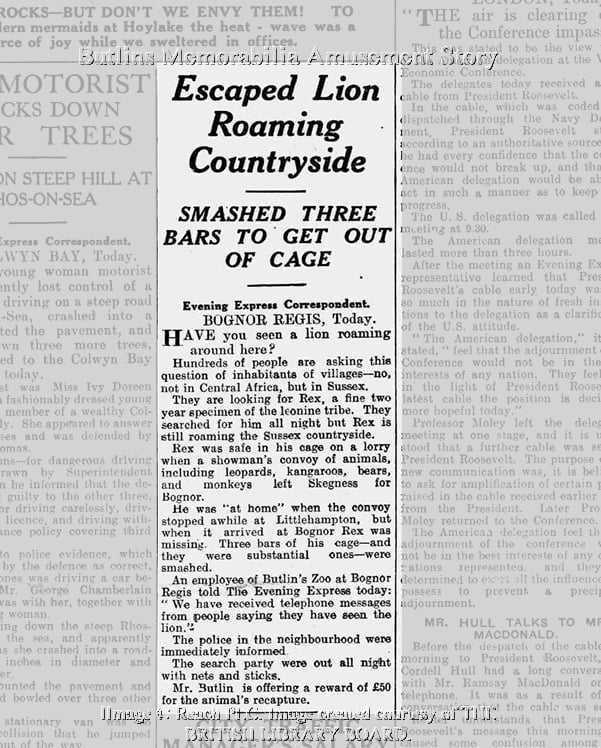
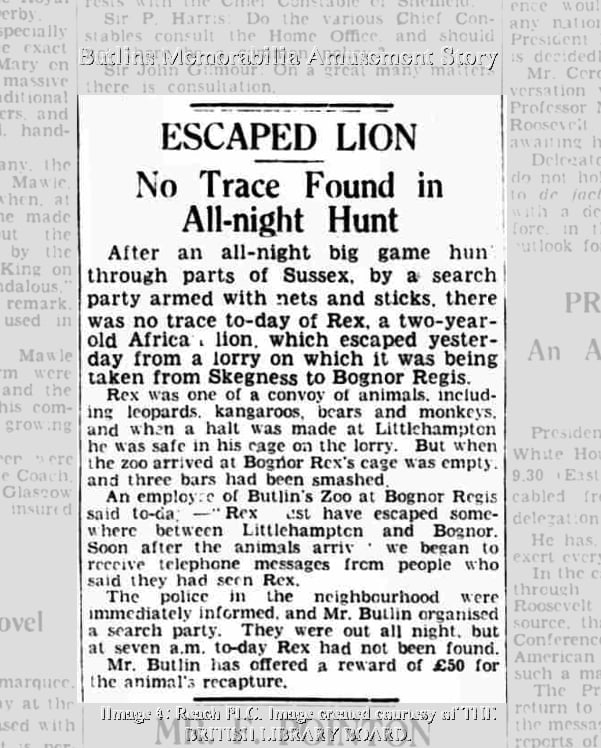
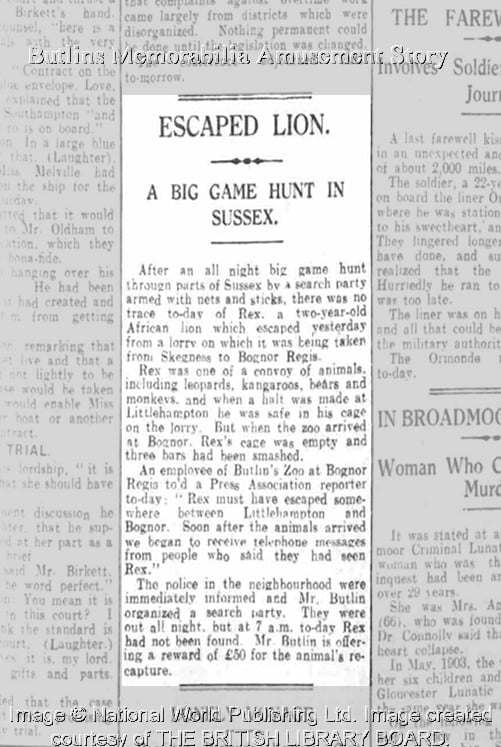
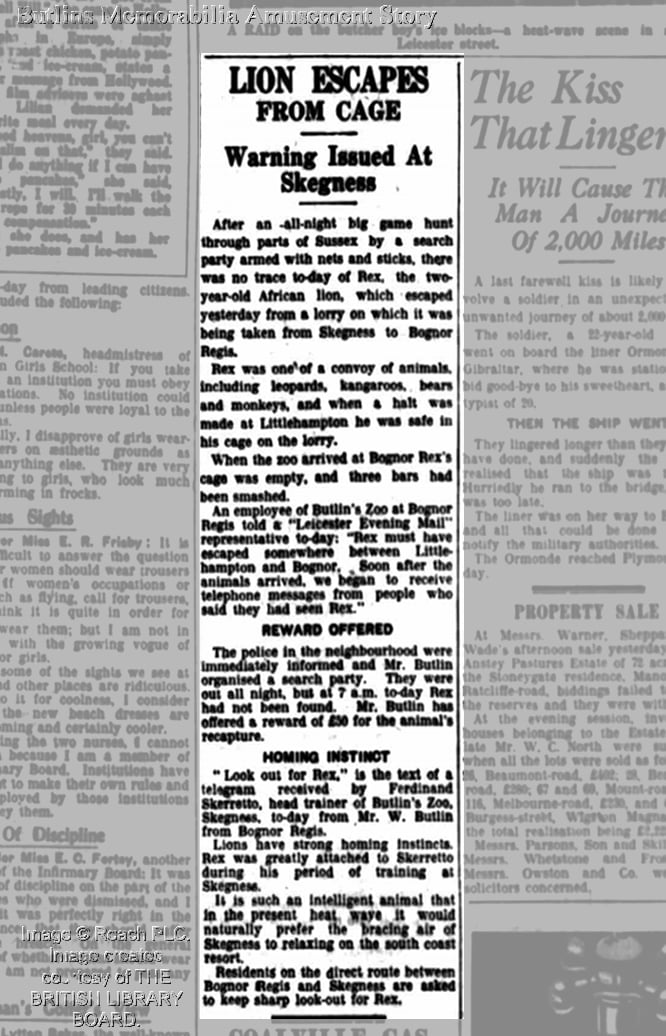
The news about Rex started to surface in the national newspapers as I came across it for the first time in my research. The Liverpool Evening Express highlighted this story on its front page, with this breaking news. Interestingly, the article mentions that the convoy had stopped in Littlehampton for a small break, but by the time it got to Bognor Regis, the bars of his cage had been smashed open, despite their strong construction. However, at this stage, Billy Butlin would not have had a chance to inspect the lorry to see the damage and was trying to find a solution to this new problem that he had. The only remarks from Butlins about the lost Lion story are "We have received phone calls from people stating they have seen the lion." One notable feature of this newspaper article is that Billy Butlin is offering a £50 reward for the capture of the animal, alive and unharmed.
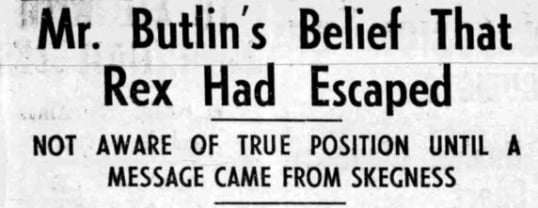
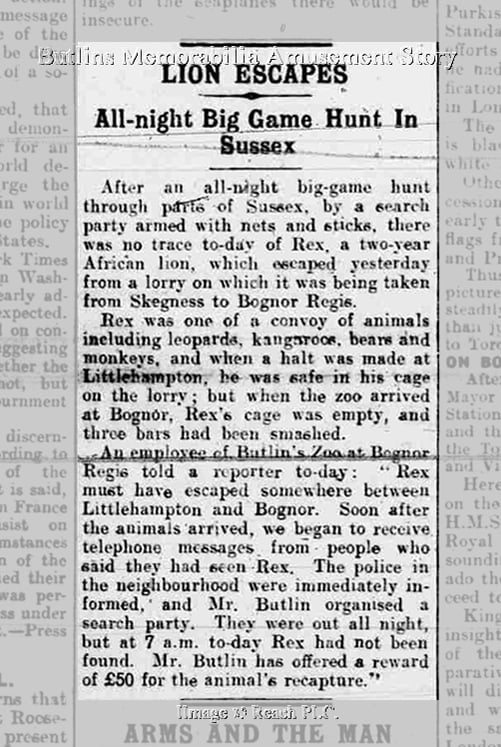
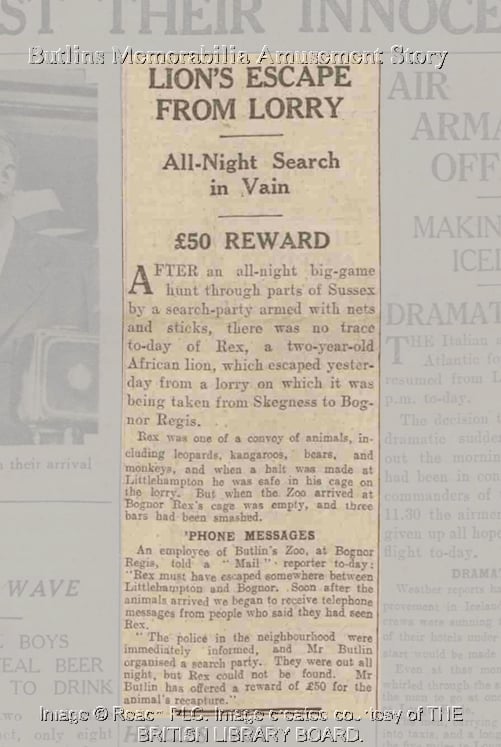
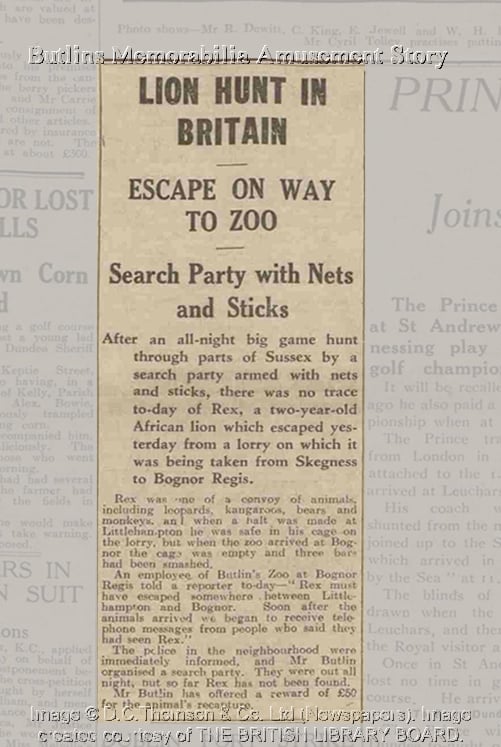
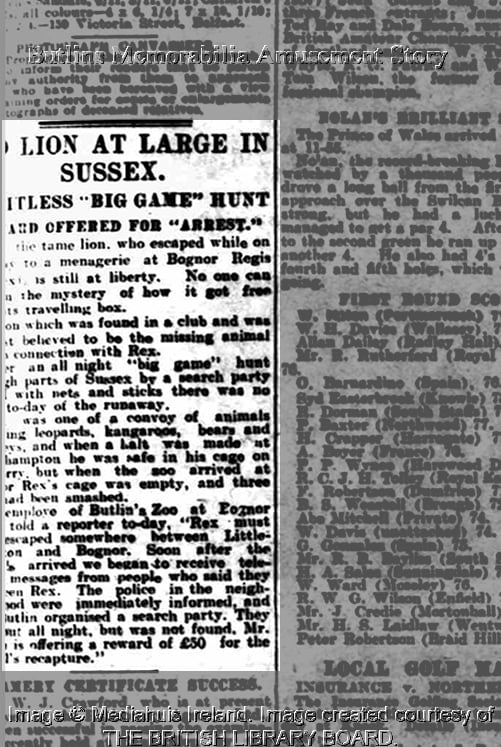
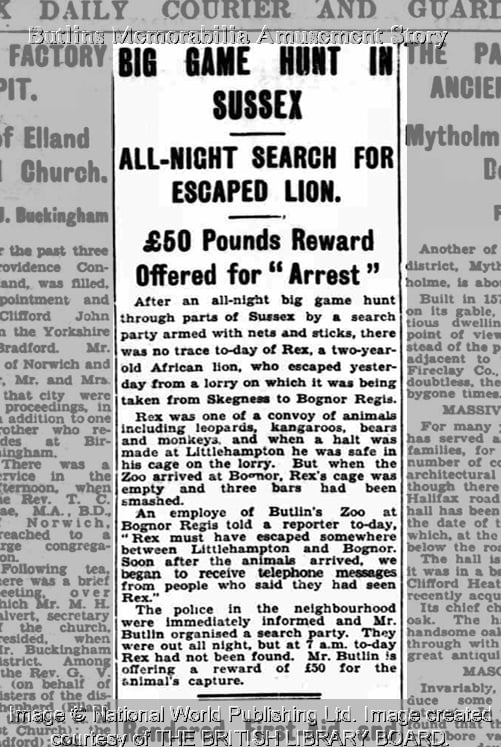
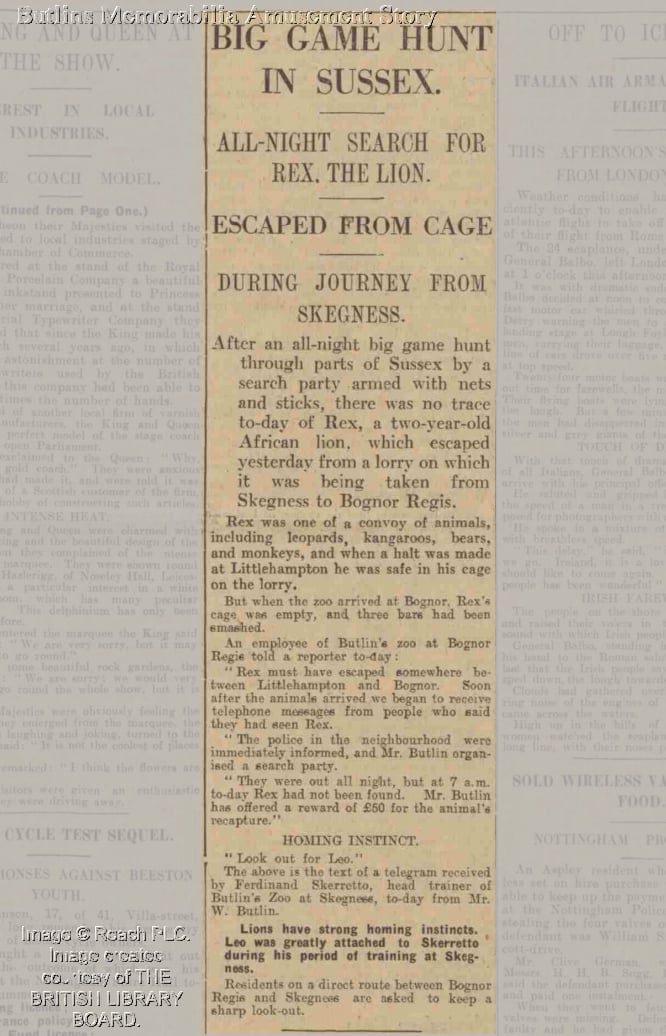
The Staffordshire Sentinel provides additional information, confirming that Rex is a two-year-old African Lion. The quote from Butlins differs from the earlier one. This time, Butlins states, "Rex has escaped somewhere between Littlehampton and Bognor. Shortly after the animals arrived, we began receiving calls from people who reported seeing Rex." It is interesting to note that the story Billy Butlin shared in his book is evidently reflected here, as he took part in the search until the early hours. Below are other newspapers that had similar reports, which show how this one story has started to spread among national newspapers. This was certainly fascinating to research and highlights how much of a businessman he is and how he wanted the public to feel safe knowing that he was searching the area with a team of professionals from his zoo. Look at the locations of these newspapers to see how far the name Butlin's zoo had progressed and how Billy Butlin was supporting the return of his lion.
I believe this newspaper had a typo in the name, as the next newspaper clipping from the Leicester Evening Mail on the same day has the same story but with the name Rex instead of Leo. The remaining telegram should say "Rex was greatly attached to Skerretto during his period of training at Skegness".
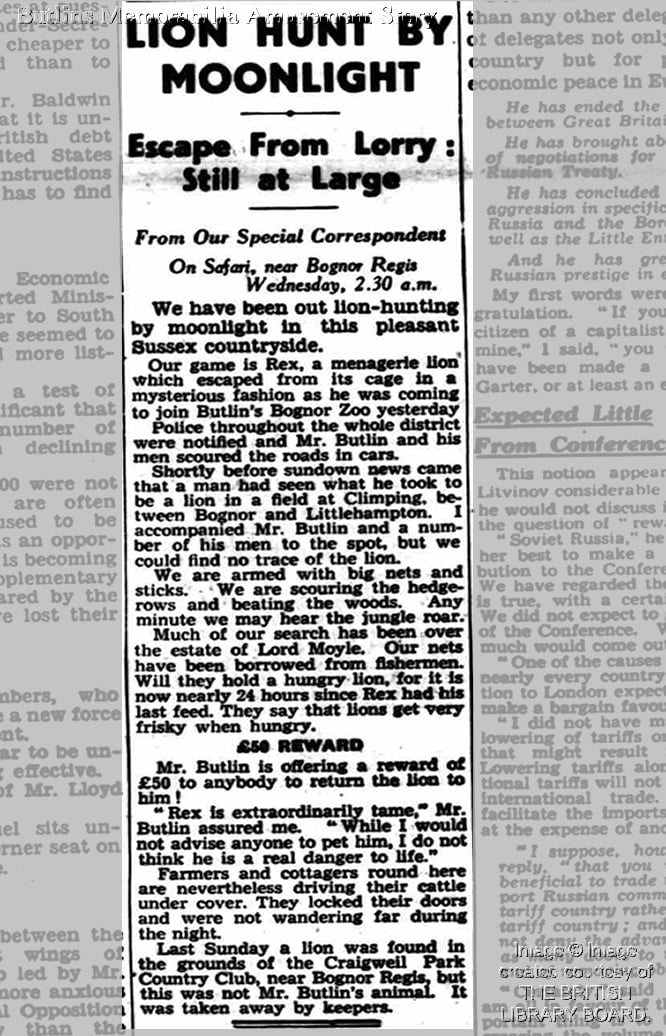
The Daily News indicates that their correspondent was out during the late hours with Billy Butlin, looking for the Lion Rex in the moonlight. The article clarifies that the way the Lion managed to escape from the cage was mysterious. This implies that the reporter was doubtful about whether the story was true or false and planned to participate in the search to determine if there were any credible leads. As they continued their search all night, a report was received stating that an individual believed he had spotted Rex in the distance.
As they journeyed to a field in Climping, situated between Bognor Regis and Littlehampton, they found nothing at the location. The search then shifted to the land owned by Lord Moyle, using nets that had been borrowed from a fisherman. Billy Butlin was quoted in a newspaper stating, "Rex is extraordinarily tame, whilst I would not advise anyone to pet him, I do not think he is a real danger to life". This reassurance, however, was insufficient for the locals and farmers, who locked their doors and secured their livestock overnight for safety. The concern arose from a report of a lion discovered on Sunday, July 2nd, in the grounds of Craigweil Park Country Club, which is near Bognor Regis, but it was confirmed that it was not related to the Butlins zoo animals.
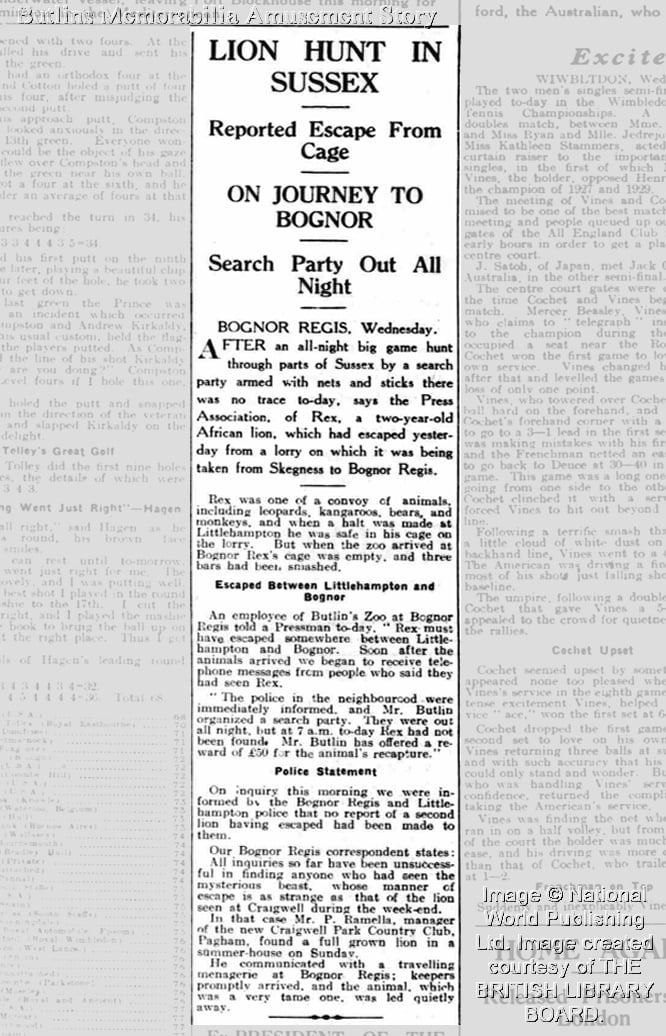
The Portsmouth Evening News contains comparable information until reaching the section with the police statement, which is not only crucial at this time but also quite amazing to read. As noted, the police have communicated to the media that neither Bognor Regis nor Littlehampton police have received any reports of a second lion escaping. From their perspective, no information has been presented to them regarding this matter, which is indeed fascinating. Keep this newspaper article in mind, as it will play a significant role in the story that follows. Interestingly, the clippings above show the police were informed about Rex being missing from the lorry.
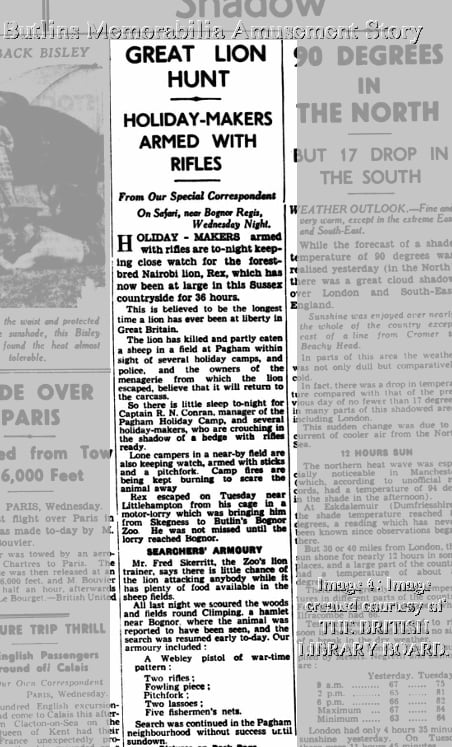
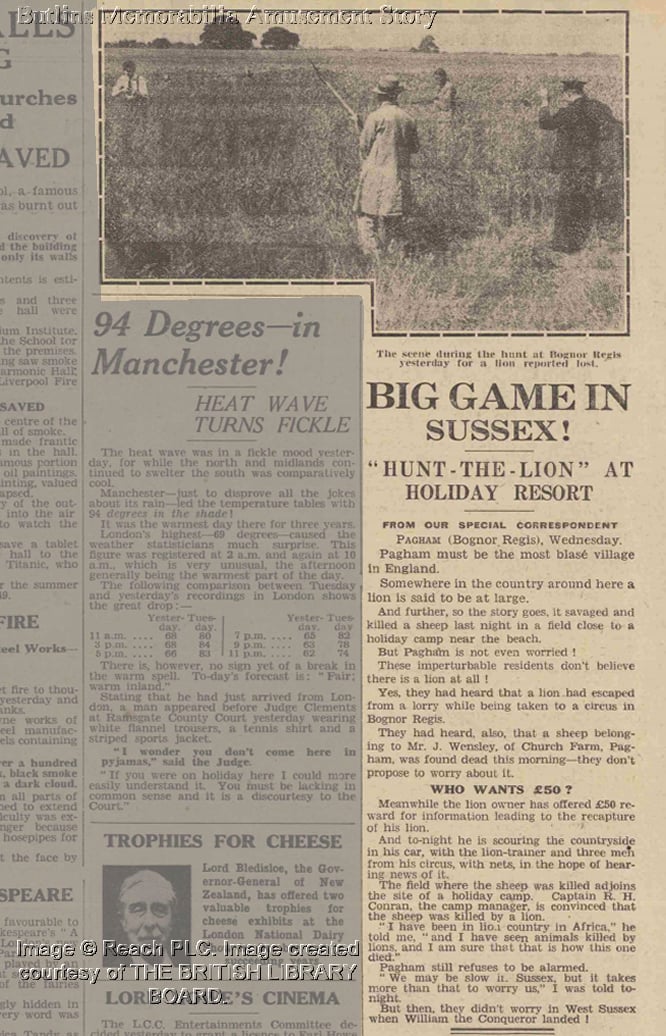
However, there was going to be a change on the 6th of July as a phone call was received from a farm owned by Mr John W Wensley, a proud farmer at Pagham Farm in Bognor Regis. He called Billy Butlin to report that one of his sheep had been killed and partially eaten by a lion, and he wanted them to come and see what they thought. Billy Butlin and his team would visit to examine the sheep, and on page 94 of his book, he admits that it appeared the sheep had indeed been killed by a lion. The news of the sheep's death at the hands of the escaped lion would be made public, with a nearby holiday camp included in the article. The Butlins Bognor Regis zoo head trainer, Mr Fred Skerritt, had also informed the newspapers, "There is little chance of the lion attacking anybody whilst it has plenty of food available in the fields". However, this small bit of advice would make people worry a little more, as those near these fields would start to feel that they were too close to where Rex might appear.
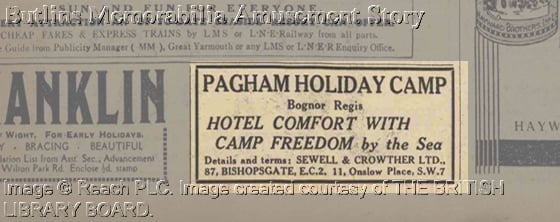
Following the report of a sheep's death in a nearby field, Captain R. N. Conran, the manager of the Pagham Holiday Camp, informed the newspapers that his campers were equipped with rifles for their protection against any potential threat from Rex. Additionally, the campers planned to light campfires in the hope that this would serve as a deterrent, scaring the lion away from the holiday camp.
The Daily Mirror had also had the story about the sheep that had been killed by the lion known to be wondering around in Sussex. The town known as Pagham was area that most people believed the lion was last seen and that it people had to be aware of their surrounds. Well, some of them did as most residents did not believe the story of this story of a loose lion in the grounds and area. It was on this day that Billy Butlin would see a message from Butlins Skegness zoo telling him that Rex was still with them and their was a mistake causing him to miss the transport. Billy Butlin must of thought relieved that his lion is safe and sound but at the same time, concerned about how this might look to the public.
Billy Butlin understood it was necessary to halt this story, as he did not want to cause any more fear among the residents or schools, which had been closed due to the fear of the lion being on the loose. Additionally, he was genuinely asking questions regarding the sheep that had been found in the field. For Billy Butlin, the sheep seemed to have been killed by a large animal, but it was not Rex, who was located in the Butlin's Skegness zoo. With doubts starting, Billy Butlin would think it would be far better to clear the air with the story of Rex for them to look for the animal that attacked this sheep.
To address concerns about people's fear, Billy Butlin arranged for the Lion Rex to be moved from his zoo in Skegness to the one in Bognor Regis. However, he faced another challenge regarding the lion's condition. Rex was in excellent health and looked impressive for a lion that had been roaming free in the wild. To create the illusion that he had been loose in the area, Billy Butlin decided to throw a bucket of green distemper over the lion. The additional problem of having Rex in Bognor Regis was to convince the public about how they had recaptured this amazing lion, as people wanted to know more and believe in a story that made them feel safe once again.
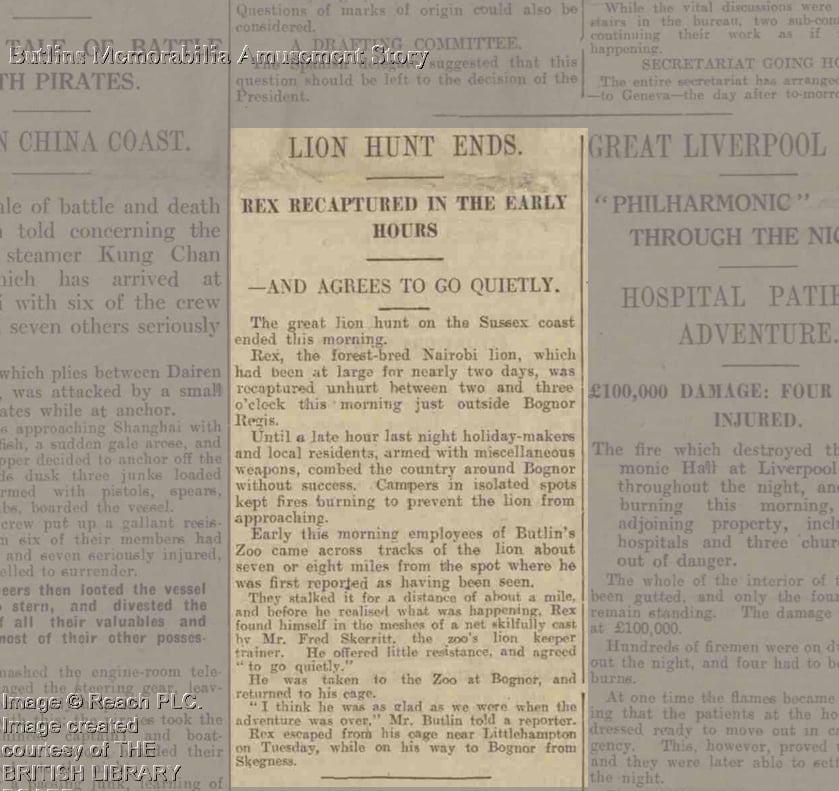
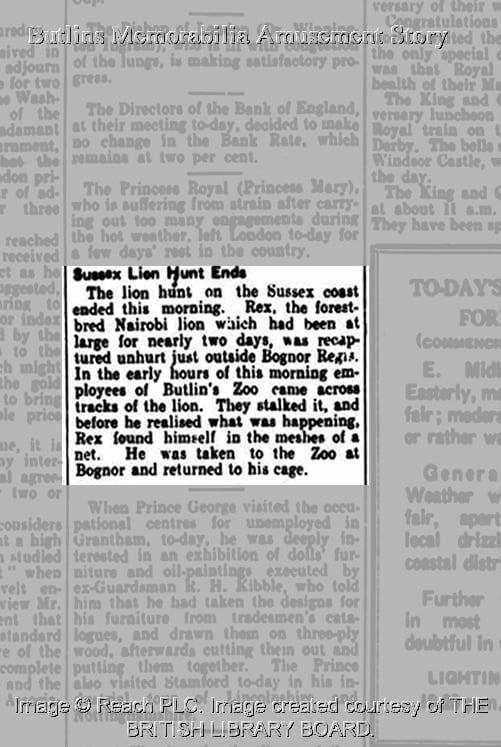
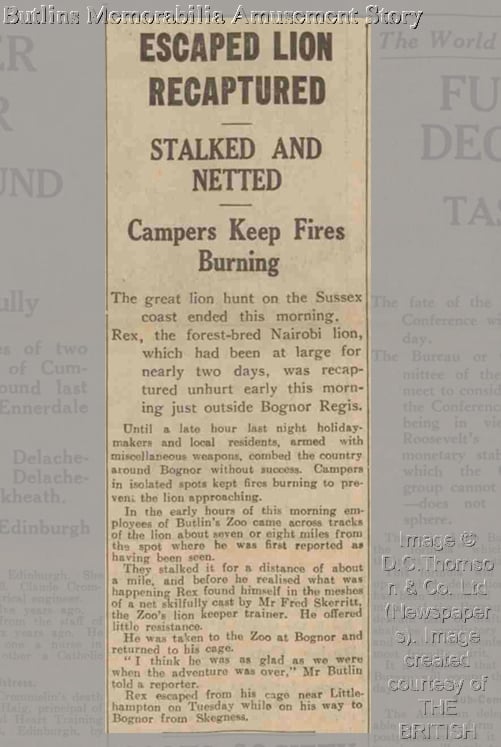
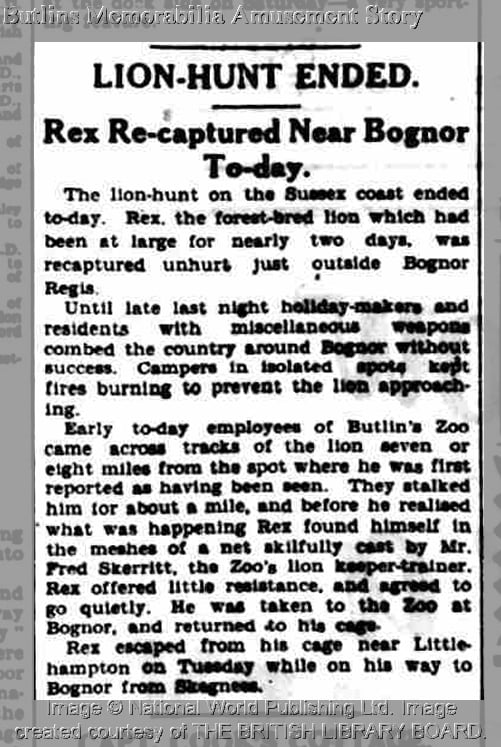
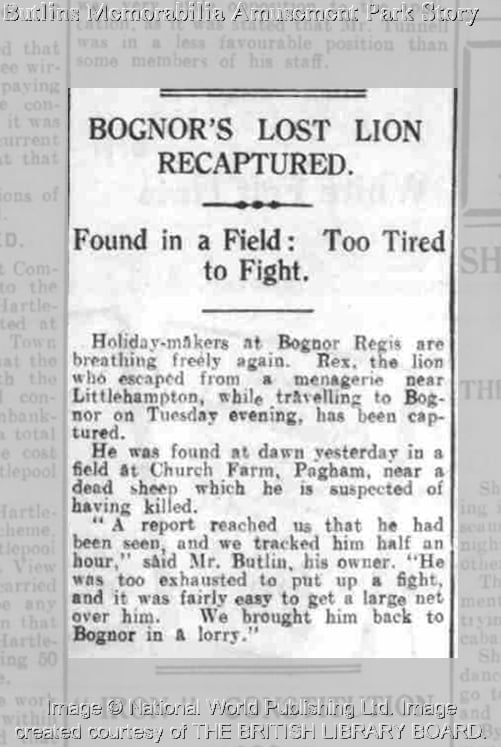
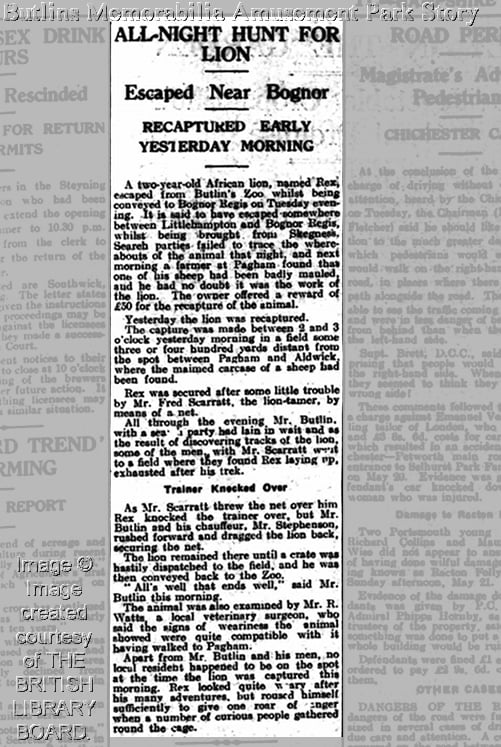
With everything set, the news was released through the newspapers, indicating that Rex was recaptured between two and three a.m. on July 6, 1933. The report explains that the staff from the Butlins Bognor Regis zoo had received information suggesting that the lion might have been seen about eight miles from the first reported sighting mentioned earlier in the news. The staff followed the tracks until they discovered Rex in the meshes, at which point Mr. Fred Skerritt threw the netting over him to prevent any further problems. Billy Butlin remarked that Rex offered very little resistance and was pleased that this ordeal had come to an end. At this moment, Billy Butlin was relieved that his plans had worked and learned a lesson from this as he tried to continue to run his business.
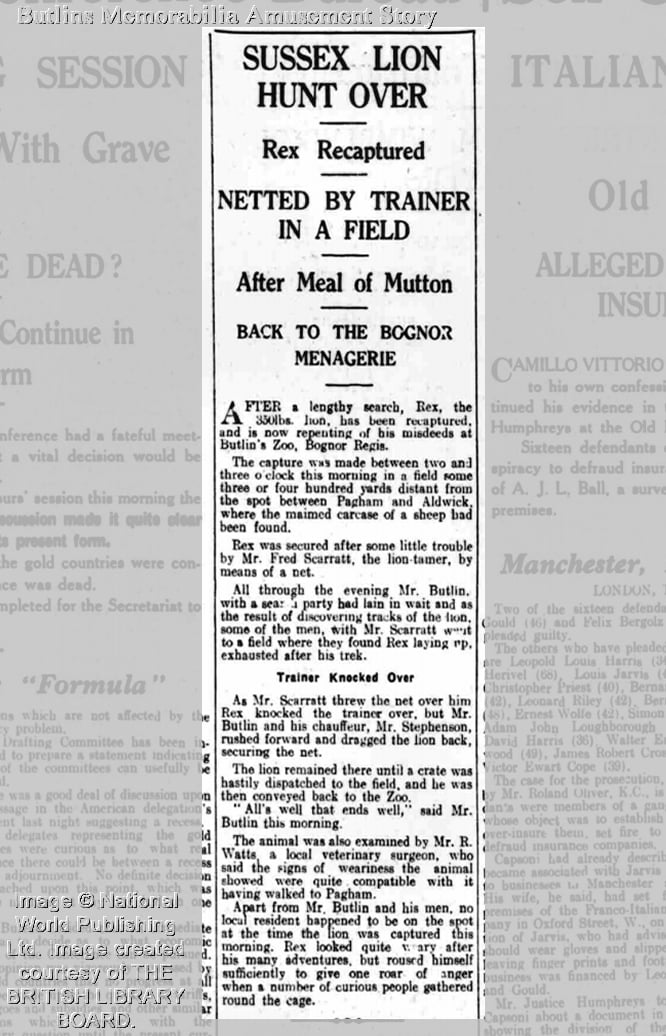
As previously mentioned, the Portsmouth Evening News provides an in-depth look at this story, offering additional insights into the recapture. The newspaper mentions that Rex, weighing 350 pounds, is now housed at the Butlins Zoo in Bognor Regis. The detailed article outlines that Rex was captured in fields between Pagham and Aldwick, near the location where sheep were killed the day prior. Echoing earlier reports, the lion's tracks were found, and by following them, the head trainer of the Butlins Zoo in Bognor Regis was able to ensnare the lion with a net and other resources.
The report indicates that Rex was worn out and did not possess the energy to resist after the head trainer, Mr Fred Skerritt, was knocked down at the outset. Nevertheless, with the presence of Billy Butlin, his chauffeur, and Mr Stephenson, they successfully managed to secure the lion in the net. While they awaited the arrival of a crate, the lion remained trapped in the net, bringing this event closer to its conclusion. I found it particularly interesting in this newspaper article that a veterinary surgeon was called in to evaluate Rex's welfare. Interestingly, he was cleared but exhibited signs of being a lion that had been wandering around the Pagham area. This was precisely what Billy Butlin required, as he aimed to ensure that his story was effective and that the public believed Rex was captured and returned to his rightful place.
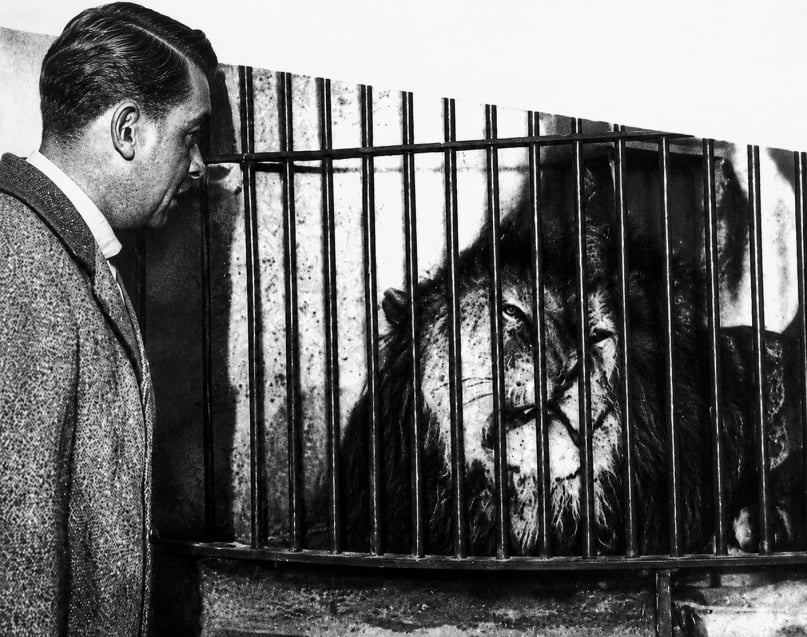
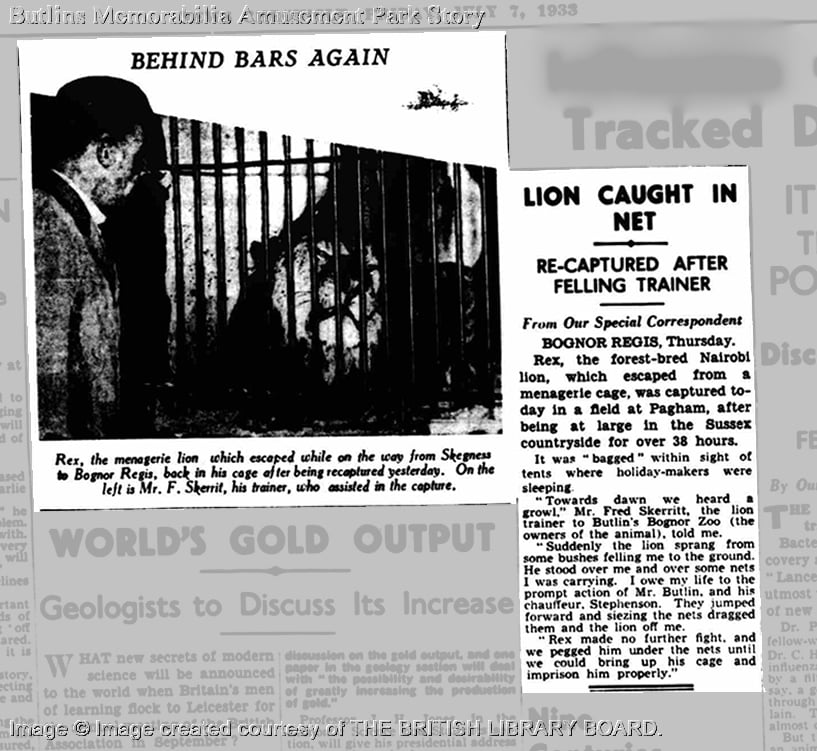
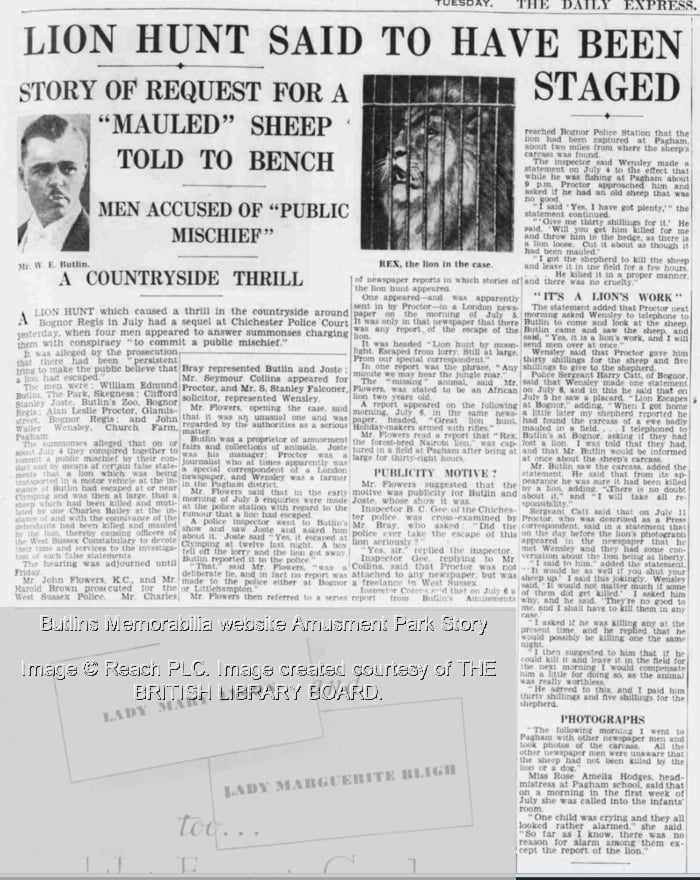
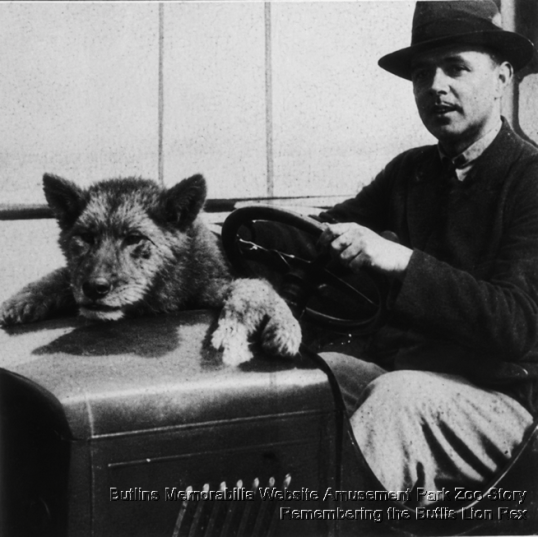
This is the original newspaper article showcasing a picture of Butlin's Lion Rex alongside his trainer, Mr. Fred Skerritt. I must confess that I am thrilled to see this image, as it allows us to view the Lion featured in the Butlin's story with his trainer. It is an incredible discovery and a remarkable moment for me. Additionally, I used ChatGPT to enhance the image used above since this original photo is considerably darker in tone, paying tribute to the significance of this important photograph. While it is possible that Mr. Fred Skerritt may not have appeared exactly as he does in the photos above, I believe it still respects the vital history, which is why I have included the original image here.
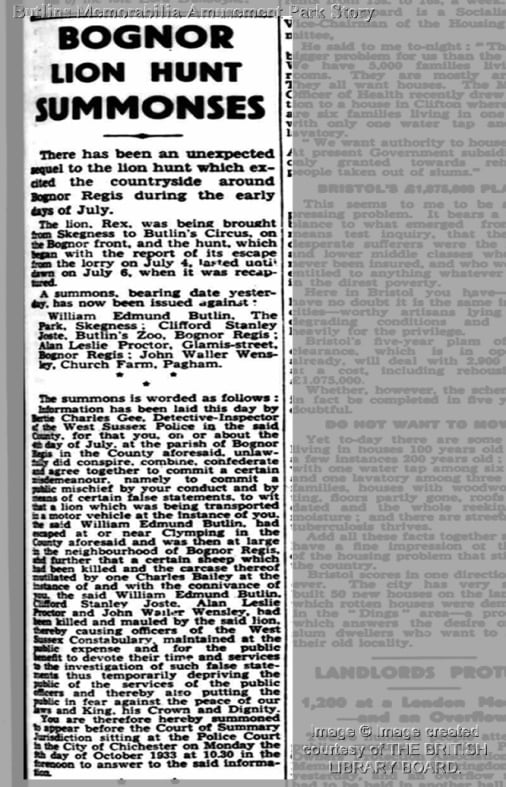
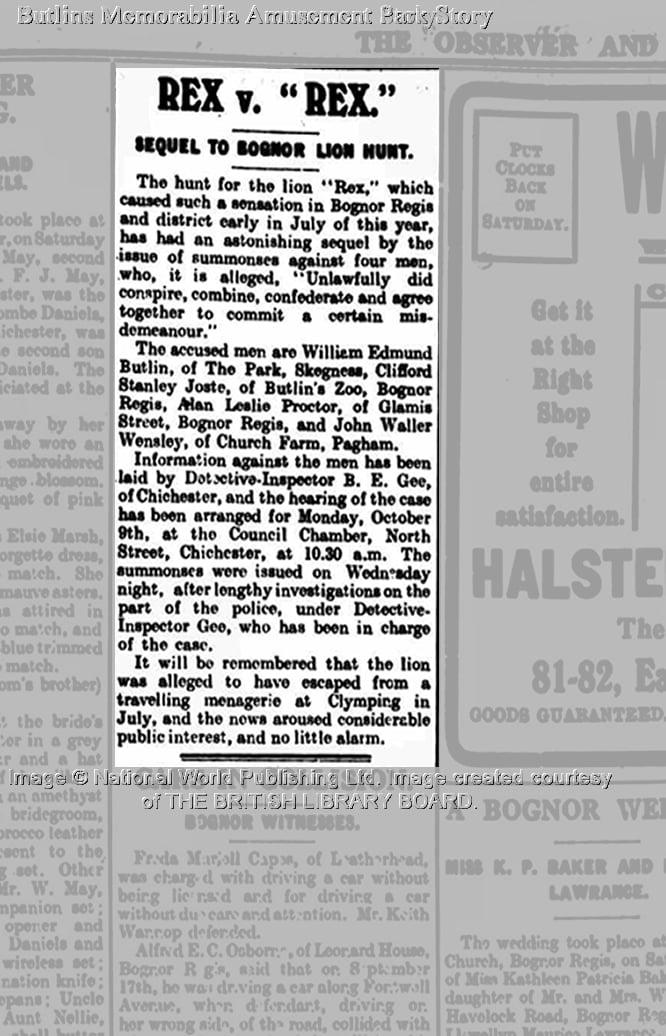
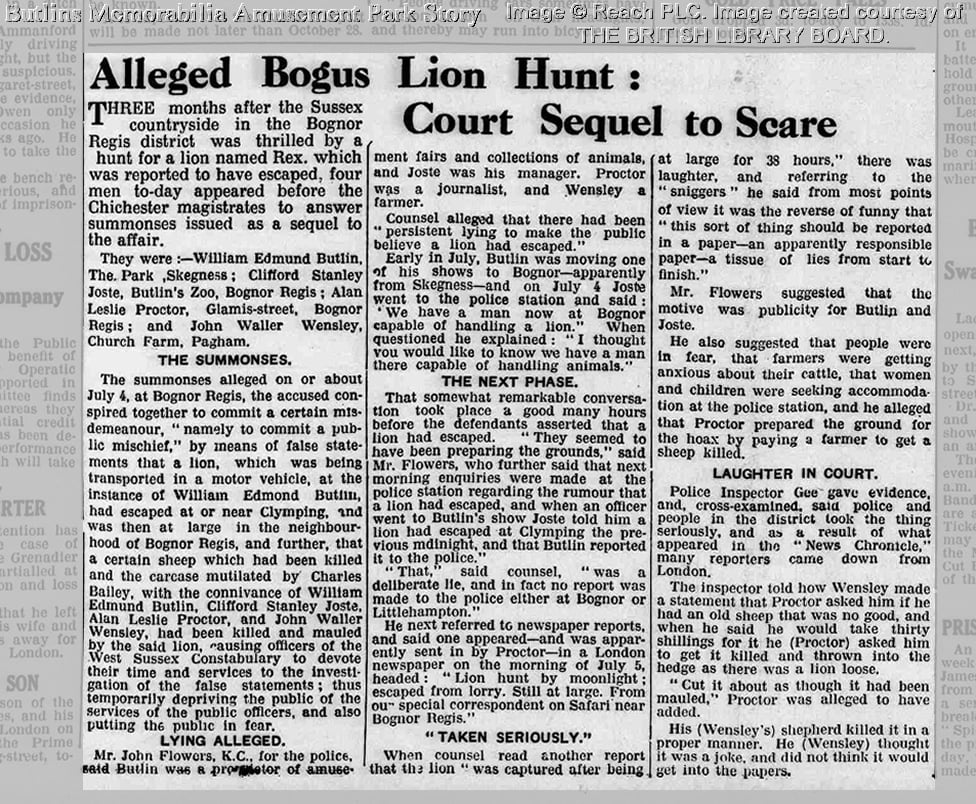
In September 1933, Billy Butlin had moved past the story of Rex as he concentrated on his business and the requirements of his customers. As with every aspect of Billy Butlin journey, there is always a challenge that he must confront and resolve. It was in September that Billy Butlin received notification that he had been summoned to court on the accusation of "Unlawfully did conspire, combine, confederate and agree together to commit a certain misdemeanour," as the tale of Rex resurfaced once more. Billy Butlin provides a brief account of this on page 95 in his remarkable "Billy Butlin Story book," but I delved deeper to uncover the details. The following individuals were summoned to appear at the Council chamber in North Street, Chichester on October 9, 1933, at 10:30 am.
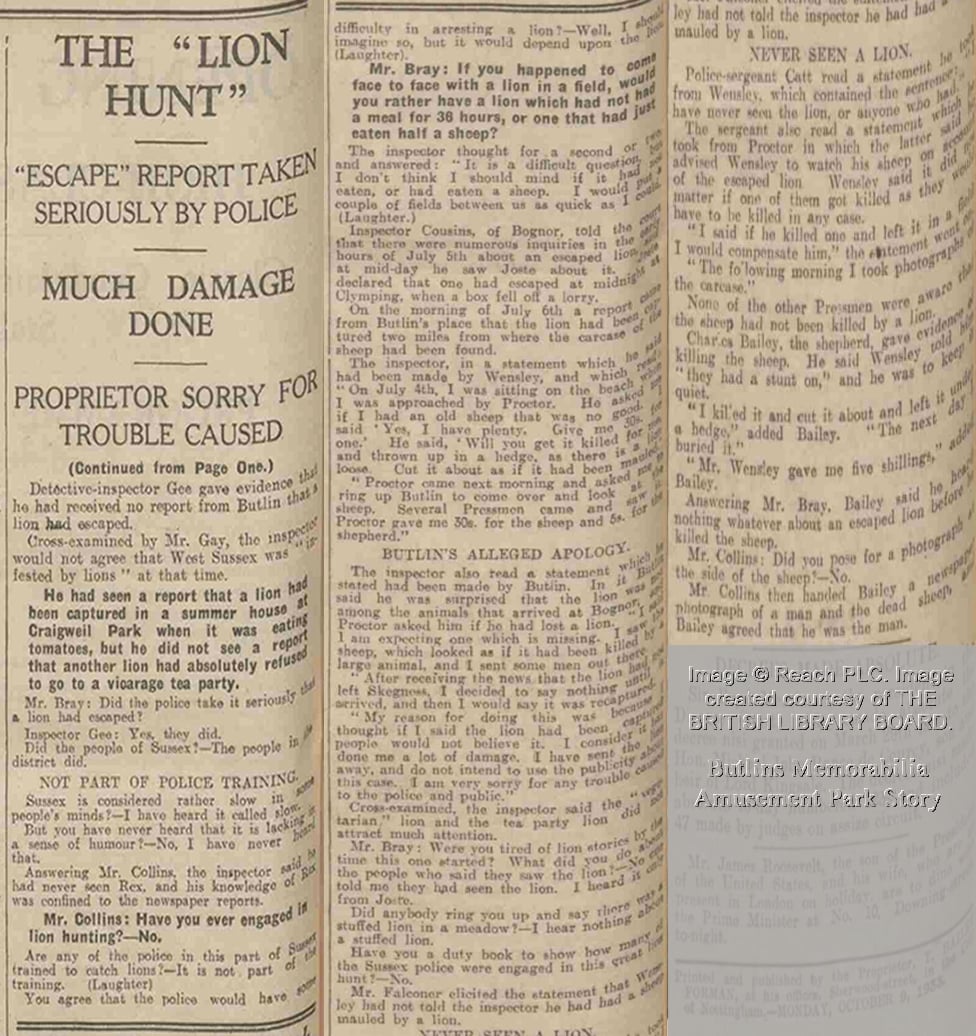
William Edmund Butlin, better known as Billy Butlin, found himself summoned to court because he owns the Butlins Bognor and Skegness zoo, and it was thought that he contributed to the extent of this story. Mr. Clifford Stanley Joste was summoned for allegedly making a false report to the police regarding a missing lion, where he reportedly claimed, "Yes, it escaped at 12 o'clock last night. A box fell out of the lorry, and the lion got away." Mr Alan Leslie Proctor was called to court as he was the reporter who relayed the information to the newspapers, and the timing of his report raised suspicions. Mr John Waller Wensley was summoned due to accusations of having killed a sheep to suggest that Rex had been in the wild.
Vernon Strokes
In preparation for his defence and to present his version of the Butlins Lion Rex story, Billy Butlin consulted his friend Vernon Strokes, whom he had met in Portsmouth while leasing land there. Mr Strokes would eventually become the deputy managing director of Butlins in the future. Below are the individuals who were to represent those in attendance (researched from the details published by the Lincolnshire Standard and Boston Guardian on Saturday 14th of October in 1933).
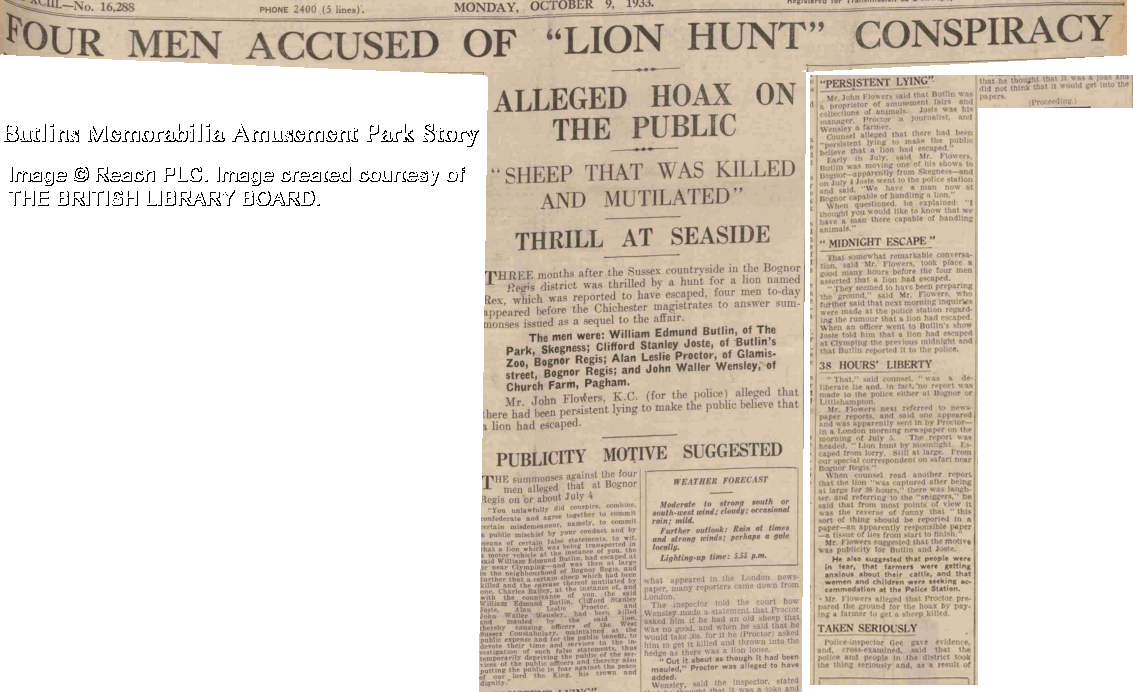
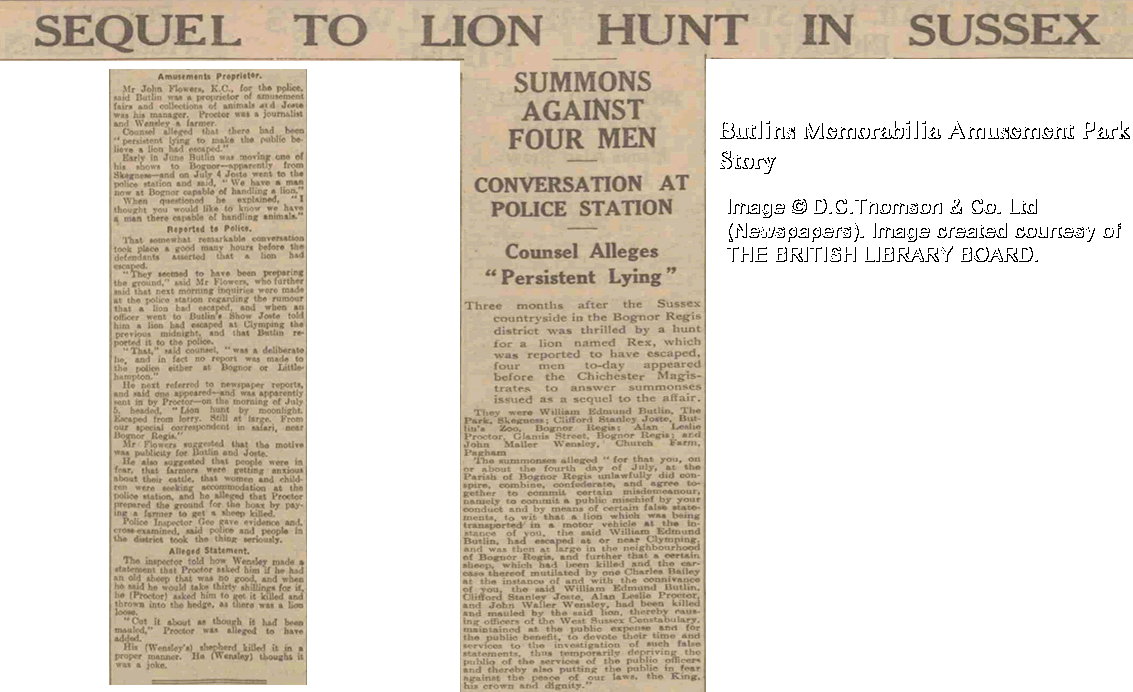
Initially scheduled for October 9th, the case was postponed until Friday, October 13th, 1933, due to issues with the witnesses at that time. Mr John Flowers would clarify that on July 4th, 1933, these four individuals were planning to commit misdemeanours and public mischief concerning the missing lion known as Rex. Mr Flowers would explain to the court that evidence shows the lion never escaped, as it was never on the transport, and that William Butlin used this opportunity to gain free publicity. The journalist had published the story in the national newspaper without the correct details, causing unnecessary alarm. The farmer had killed an unwell sheep to mislead the public and, more importantly, the newspapers into believing that the lion, Rex, was in the area, prompting schools and residents to be cautious when it was unwarranted. He stressed to everyone that this case should not be viewed as humorous or a joke, but rather as a serious matter, as the panic over those two days had significantly affected many people from Bognor Regis to Littlehampton.
Mr Flowers explained that it was Mr Joste who had informed the police station in Bognor Regis about some animals being transported to the town. However, what was unusual was that Inspector Couzens (also seen spelt as Cousins in some newspapers) had asked why he felt the need to notify them, to which he replied it was because a lion was included. I believe this concern arose because a week prior to Rex's arrival, another lion had escaped and was recaptured in Bognor Regis. The inspector found it interesting that shortly thereafter, a report was submitted to the police indicating that a lion had escaped during transport to the Butlins Bognor Regis zoo. Now, before I proceed to explain what has been presented to me, let us return to the newspaper "Portsmouth Evening News - Wednesday 05 July 1933 (link to see it). In this article, it clearly states that the police mentioned in a statement that no report had been made to them (something to keep in mind).
As the case progressed, Mr Flowers shifted his attention to the sheep that was allegedly killed by the lion. Evidence indicated that this was not true, and Mr Wensley had received 30 shillings from the journalist to kill a sheep that was not in good health, in order to disguise the act as an attack by the lion. This incident would have several repercussions, including a payout for the journalist, a higher likelihood of newspaper headlines, and increased concern among the local residents. Notably, the farmer, Mr. J. Wensley, made a statement about his involvement in this case, explaining that he had spoken to a shepherd named Baily and inquired if there was an old, unwell sheep that could be killed to make it appear as though it had been attacked by the lion.
Mr. Wensley further explained that on the evening of July 4th, the journalist, Mr. Proctor, had informed him that a lion was loose after escaping from the transport to the Butlins Bognor Regis zoo. It was at this part of the plan that these two had the sheep killed, with the reporter providing guidance on how to make it appear realistic. The farmer indicated that the journalist needed the sheep to look as though it had been attacked by the lion for this task. If he complied with these instructions, he would be significantly compensated for his efforts. What undermined the farmer and the journalist was the testimony of the shepherd, Charles Bailey, who stated he was told they were both involved in a stunt and instructed to keep it secret, for which he was paid five shillings.
In court, Detective Inspector Gee provided evidence, stating that Mr Butlin had not reported the lion's escape. He explained that there had been a previous case of an escaped lion, which was located in Craigwell Park, eating tomatoes and was recovered. However, regarding the Butlins lion, he had not received any report of it being missing. When the news came in, Mr Gee was asked by Mr Bray, "Did the police regard this situation as serious?" to which he responded, "Yes, they did." The inspector informed the court that it was not until July 5th that Mr Joste reported the lion missing, and on July 6th, he received another report confirming that the lion had been recaptured.
This was split into two due to its size
This was split into three due to its size
On page 95 in the Butlins story book, we read that Billy Butlin chose to tell the truth about his and the manager of the Butlins zoos involement in the story of Rex the Lions escape. Remember from above that Billy Butlin explains that he told the reporter that he was unsure about the whereabouts of Rex but needed to check. Opting to tell the truth, here is the highlights of what put in his statement.
Additionally, what made this research interesting was that Billy Butlin name appears in all the headlines, yet the stories primarily concentrate on the journalist and the farmer. He has stated that he is sorry for everything that has occurred and is even willing to take full responsibility for the sheep's death, despite the fact that his lion was not responsible for the killing. As I continue to read more newspaper articles, I find that Billy Butlin is not mentioned very often, which leads me to question why his name is being used as the main headline. The answer to this question can be found below, simply by examining the title he was known for back in the 1930s.
Billy Butlin was beginning to gain media attention, with some referring to him as the Skegness Amusement King. However, this publicity was not what he desired, as negative reviews continued to emerge. I have collected over 24 newspapers that recount this story, but interestingly, while Billy Butlin's name is mentioned, the focus is primarily on the journalist and the farmer. A significant issue for all four individuals involved was that Miss Rose Amelia Hodges, the headmistress of Pagham school, informed the court that her students were extremely distressed by the notion of a loose lion outside, with one child even crying. This situation would have severely affected Billy Butlin, as he had never anticipated such an occurrence. By the end of Monday, October 9th, the case was postponed until Friday, October 13th.
On October 11, 1933, a newspaper article from the Skegness News was published that would provide significant insights into the case. Titled "Amazing Sequel to Sussex Lion Hunt," I believe Billy Butlin was taken by surprise by this connection to the Skegness area. The newspaper continues to report similar information until further details emerge regarding Billy Butlin's statement.
"After receiving the news that the lion had not left Skegness, I decided to say nothing until it arrived, and then I would say it was captured. My reason for doing this was because I thought if I said the lion had been captured, people would not believe it. I consider it had done me a lot of damage. I have sent the lion away, and do not intend to use the publicity about this case. I am very sorry for any trouble caused to the Police and the public"
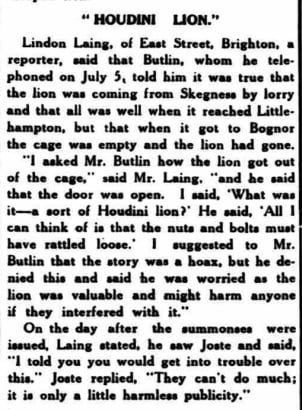
What caught my attention in this newspaper article was the paragraph named "Houdini Lion," in which Mr. Lindon Laing from Brighton was called to testify. He was queried about his understanding of the incidents that unfolded, and he recounted that Billy Butlin had mentioned, "the door was open to the cage. All I can think of is that the nuts and bolts must have rattled off." Mr. Lindon did not accept this explanation and suggested that he thinks it is all a hoax, a notion that Billy Butlin dismissed.
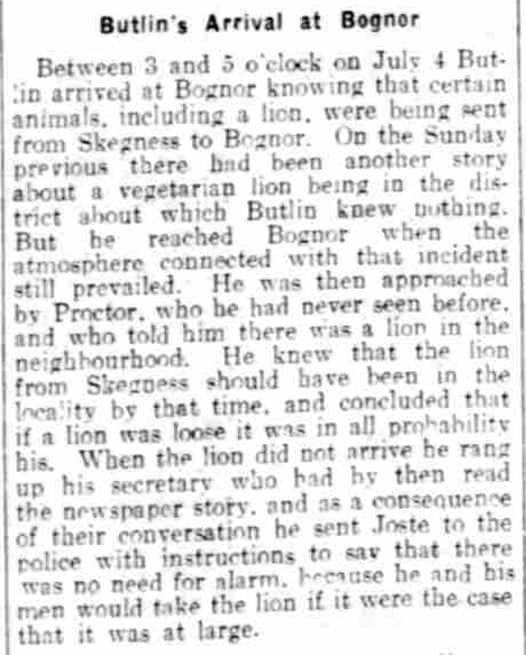
On page 93 of the Billy Butlin storybook, it is revealed that when Mr Procter asked if the lion was missing, Butlin would have answered, "I don't know." Above is a portion of the Portsmouth Eventing newspaper, dated Friday, October 13, 1933, which explains more about the situation. For those who may not see it clearly, the brief article states that Billy Butlin was unsure of Rex's location but would attempt to find out. After reaching out to Skegness, his secretary informed him that Rex should have been on the transport. At that moment, Billy Butlin instructed his manager, Mr Joste, to report this to the police. Billy Butlin was asked about how the news of Rex's escape developed, to which he replied, "I had at that time heard a lion was out; all my staff were talking about it. When all the animals came from Skegness and the lion was not among them, I telephoned Skegness and learned that all the animals had left that morning. I did at the time believe that Rex was out in the town and told my manager, Mr Joste, to report this to the police". Billy Butlin also mentioned that he was not involved in any agreement to fabricate a story to mislead the police or to gain publicity.
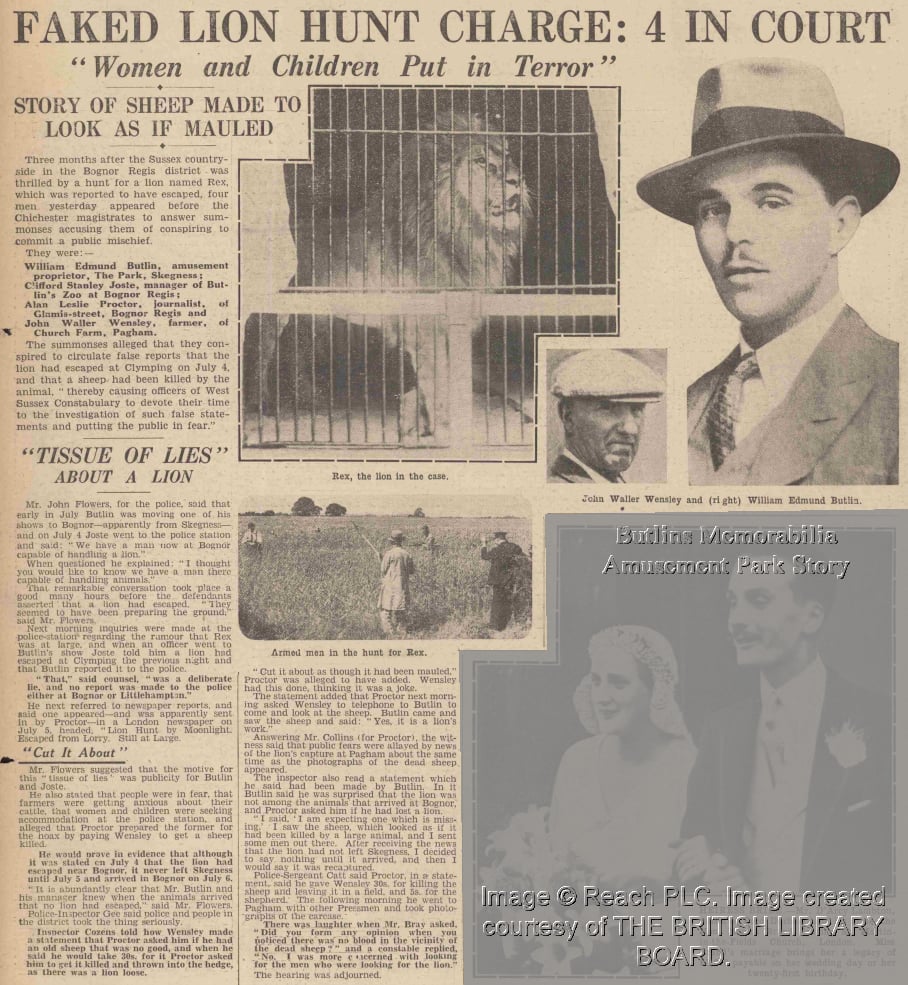
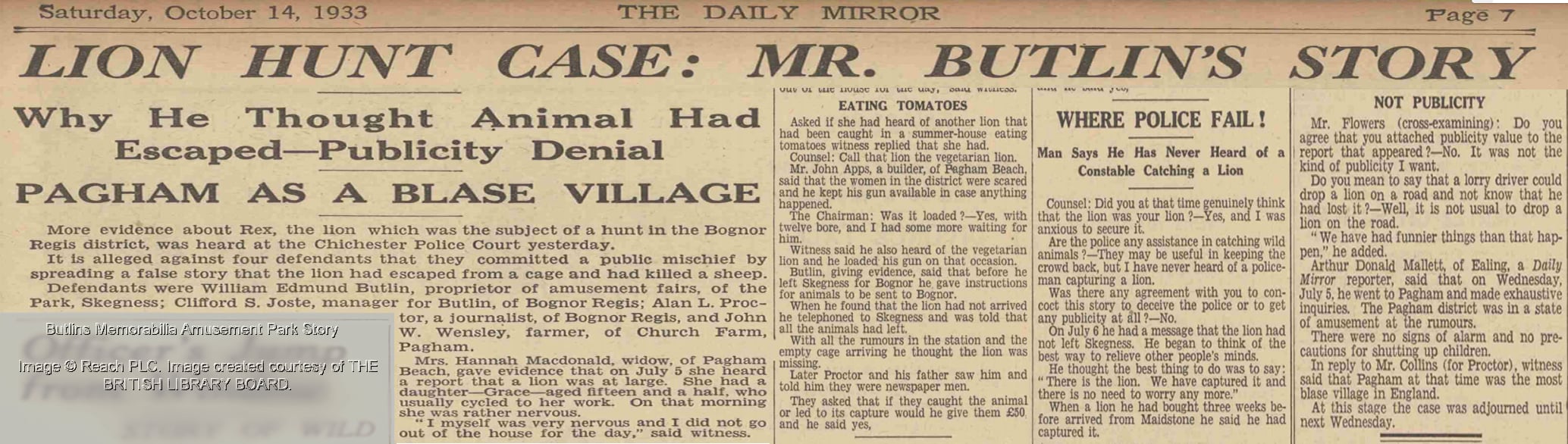
The Daily Mirror reported on this story in its edition dated Saturday, October 14, 1933, providing further insights into the Rex story. The image above has been adjusted in size, as it originally occupied almost an entire page; however, upon examining the story, it becomes clear that the Daily Mirror reporter delivers a comprehensive account of this important event. The article revisits the previously discussed story while also presenting a new witness, Mrs Hannah Macdonald, a widow living in Pagham Beach. She testified in court that the report of the missing lion had made her granddaughter, Grace, who was fifteen at the time, anxious about venturing outside. Mrs. Hannah particularly drew the attention of Mr. Flowers, who aimed to emphasise the serious consequences this incident had triggered. Like other newspapers, Billy is mentioned in the headline, but the publication places greater emphasis on the other individuals involved. Additionally, the residents of Bognor Regis and Littlehampton were still dealing with the lion that had escaped the previous week, referred to as the vegetable Lion. With that story still vivid in their memories, this new development would heighten the residents' awareness of the situation, leading to increased caution among the populace.
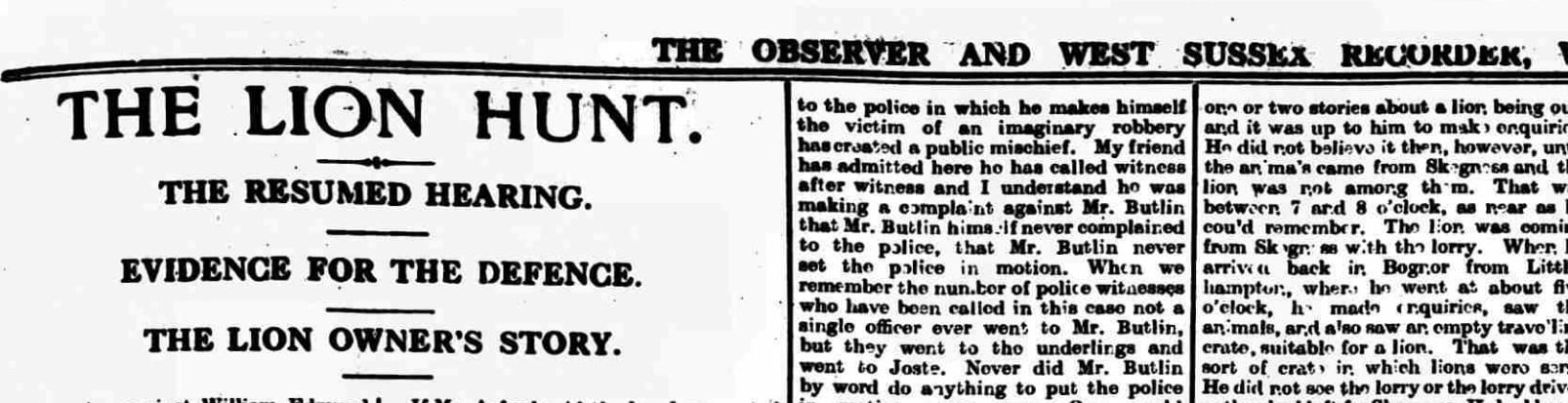
The case is scheduled to continue on Wednesday, October 18, 1933. The Portsmouth Evening News, along with the Observer and West Sussex Recorder, has released a detailed article outlining the latest updates regarding this court case in Chichester, offering significantly more comprehensive insights into the events that unfolded (I couldn't display the entire page as it exceeds the available space, resulting in very small text). The article mentions that the case is being presided over by Mr W. H. B. Fletcher (in the chair), Mr J. A. Greenwood, and Mr A. Seymour. Furthermore, it was noted that in addition to Mr John Flowers K.C., Mr H. E. Browne is also representing the prosecution. The first witness called to testify was the veterinary surgeon, Rupert Watts, who had been a client of the Billy Butlin zoo in Bognor Regis. Mr Rupert Watts confirmed that he was asked to attend the Butlins Bognor Regis zoo on the 6th July 1933 at 9:45 am. Having arrived at 11 am, he was asked to check the lion that had been recaptured and on arrival, he could see that the Lion was in good condition.
Mr Bray then began to question other witnesses, Mrs H McDonald, who informed the court that her daughter was afraid to cycle to work due to concerns about a loose lion. When asked how she became aware of this situation, Mrs McDonald explained that her daughter worked at a newsagent's, which is how she learned about the news. The next witness was Mr J Apps, who was a builder in Pagham in 1933. He confirmed that he was cautious about the possibility of the lion being in the area. Mr Apps told the court that he is a recognised coastguard and observed that some people were on the beach treating the day as if it were normal, while others remained in their bungalows. Mr Bray aimed to demonstrate that life in the area was nearly as normal as possible, suggesting that reports of people being terrified might be exaggerated in the newspapers. The witness had told the court that there were quite a lot of people treating the day as normal, but fewer than they should have been.
The court's focus would now turn to the police, where P.C. Dunkeley from the Littlehampton police station confirmed that no report of the missing lion was made on the 4th, 5th, and 9th of July 1933 by Billy Butlin or on his behalf. However, when questioned by Mr Flowers, the P.C. explained that there were seven other officers on duty with Inspector Stripp as the officer in charge. He stated that if there had been any report regarding the missing lion, he would have been notified, and he confirmed that nothing was reported to him.
Mr Bray subsequently addressed the jury, engaging with them for fifty-two minutes to clarify that this was a unique case involving Mr Butlin. He delved deeper into the legal aspects and urged the court to consider the evidence presented. Mr Bray recognised that the police had been pulled from their usual responsibilities to investigate an unnecessary issue, which led to public disorder and panic. Nonetheless, he pointed out, "that when persons are charged with conspiracy it is absolutely essential that the laws of evidence should be very, very strictly regarded, because in the case of conspiracy, where you can give evidence which is evidence against one conspirator, because it is conspiracy, it would not be evidence against the other conspirators but might be so if it was individual charge". These were his statements made in court on that day.
During his address to the Jury, Mr Bray conveyed, "If there is no common agreement, there is no conspiracy." Throughout the case, he attentively listened to evidence that suggested an agreement on where to meet, when to convene, and what their shared goals were. He asserted that without any discussion on this topic, it could not be classified as a conspiracy, as it requires at least two individuals to have a mutual agreement. Mr Bray asked the jury, "When was there, and when is there any evidence of common agreement as far as Mr Butlin is concerned?" The jury was informed that there were no specific directives from Billy Butlin to lie to the press, nor was there any evidence of criminal intent or wrongdoing on his part. Additionally, it was highlighted in court that Mr Butlin had never reported anything to the police or initiated police action. Evidence indicated that no police officer was called to Mr Butlin, but they did visit Mr Joste and others.
Mr Bray points out that this case is surrounded by media coverage, which he claims he has no issue with; however, they do aim to publish stories that can attract customers. On the other hand, Mr Bray tells the court that Mr Butlin never stated those words in print and that he had no knowledge that anything he would say could result in his presence in court later on. When inquiries were made regarding the lion's whereabouts, a miscommunication between Mr Butlin and his secretary led to the escalation of this issue to the level mentioned above. Further details emerged when Billy Butlin was asked, "What is the lion worth?" He replied, "If I get that lion back, it is worth £50 to me." Mr Bray was fair in highlighting to the jury that Billy Butlin was also seeking publicity from this story, which was not a wise move.
Mr Burrows
Billy Butlin stated that he operates in 23 different towns and employs approximately 2000 staff members during the summer season. His Butlins brand has its own publicity department, overseen by Mr. Burrows. Mr. Burrows was not contacted regarding the use of Rex for publicity and instructed the Lion to return to Skegness after the public announcement was made. Billy Butlin informed the court of his intention to open a zoo at his Bognor Regis park on July 6, 1933. Mr. Joste, the manager of the games park, had no involvement or authority over the zoo area that was proposed for the park. Bognor Regis was not the sole location where he intended to feature animals, as his plans also included sites in Felixstowe and London.
Source for above: The Observer and West Sussex Recorder
Ernest Newscome
As the case continued after the interval, Mr Ernest Newscome, a member of the Butlins staff and secretary to Billy Butlin in 1933, became a key witness. On July 3, 1933, he was at the Butlins head office (Skegness in 1933), arranging for the animals to be transported to the new Butlins Bognor Regis zoo for their arrival on July 4. Mr Newscome explained that he had organised two lorries for this important transfer and personally witnessed everything until they departed. While the lorries were en route, Mr Ernest continued with his work and informed Billy Butlin that the animals were on their way. At 7 PM on July 4, he received a call from Billy Butlin asking if Rex had been loaded onto the van for transport. Mr Ernest Newscome testified that Rex was indeed loaded onto the lorry and should have been included in one of the two vehicles.
On July 5, Mr Ernest saw a report about the escaped lion in the news chronicle at 3 PM and began to wonder if he had actually seen Rex being loaded. To confirm the details, Mr Ernest Newscome made inquiries and learned that Rex was still in Skegness. He immediately reached out to the Butlins Bognor Regis zoo to provide updates, but he did not inform Billy Butlin directly and spoke to Bertha Butlin, Billy Butlin mother. He later notified the court that the empty cage on the lorry was intended to be dev London, which was a common practice for transporting empty cages. However, there may have been some confusion, leading to the assumption that this empty cage could have housed Rex, and with it being empty, it was presumed that he had escaped.
Clifford Stanley Joste
Mr Joste would now take the witness stand and inform the court that the amusement park at Butlins Bognor Regis had been in operation for four years and that a zoo was set to open in the summer. However, he clarified that he did not manage the zoo, only the amusement park. He was aware of the animals being transported and had heard from two out of three people about a Butlins lion that had escaped. He received a phone call from an unidentified individual who notified him that the lion had been sighted in the vicinity of Clymping. Mr Joste had then informed Billy Butlin, who directed him to report to the police but advised him not to alarm them, as there was someone present who could handle the animal and that a search would start immediately.
Before entering the police station, Mr Proctor, the journalist, had observed him outside, but at that moment, Mr Joste had no idea who he was. While reporting the lost lion to Inspector Couzens, he detailed the phone call and message that Billy Butlin had conveyed to him. The inspector inquired, "Is that the same one that consumed the tomatoes in the greenhouse at Craigwell?" to which he replied, "No, we do not let our animals out." Shortly thereafter, the News Chronicle questioned him about the missing lion, to which he responded, "You would be better off asking Mr Butlin." On 5th July, Inspector Couzens encountered a significant number of reporters inquiring about the escaped lion. When asked in court if he was a part of a team that was developing a plan to mislead the public with the lion escaping, Mr Joste would deny having agreed with Mr Proctor to create any false reports and stated that he had never seen Mr Wensley until the first day of court.
Billy Butlin
Interestingly, during the continuation of the cross-examination, it was acknowledged that the news chronicle's report regarding the lion being captured at night was incorrect and false. He clarified that Mr Butlin had requested that the reports and police be notified once Rex arrived at the Bognor Regis zoo. It was believed that the local residents would prefer to see the lion in the zoo and any claims without evidence would not be listened to. The representative for Billy Butlin and Mr Joste informed the court that the prosecution had failed to establish any case against them, deeming it a waste of public funds due to the lack of evidence supporting the allegations against the two. Mr Bray emphasised that there was no evidence to substantiate the claim that both Mr Billy Butlin and Mr. Clifford Joste had not formed a connection with the other two individuals to conspire in this falsehood and the alleged offences.
During the cross-examination, Mr Proctor acknowledged that he had spoken with Billy Butlin in an attempt to gather more information regarding a rumour about a missing lion. While Billy Butlin did not dispute the existence of a missing lion, he mentioned that there were some animals en route. He informed the young reporter that he preferred no reports to be made until he had definitively learned more about the lion's whereabouts. Following a phone call with Mr Ernest, Billy Butlin indicated that there was a possibility that the lion on the loose belonged to him and that he would offer £50 for any information leading to its recovery. It was revealed that his father had submitted the story, and that much of it was not authored by Mr Proctor. Mr Flowers had then asked this question to Billy Butlin "You saw the report in the News Chronicle on the morning of July 5th. Do you agree with your counsel's observation that you attached publicity to it?" Billy responded with a firm "No, it was not the kind of publicity I wanted".
Source for above writing: The Portsmouth Evening News
Mr. Flowers then proceeded to exert further pressure on Billy Butlin by accusing him of attempting to shift all the blame onto his manager, Mr Joste. It was insinuated that Mr Butlin was trying to pass the responsibility for the incident onto his staff, thus placing himself in a favourable position. This also involved contacting the police, where Mr Flowers would question why Billy Butlin had not reported these matters to the police on his own. However, Billy Butlin would confidently counter that the statement was incorrect. It was at this juncture that the conversation turned to the question.
Mr Flowers: "Yet you and your men went over to Wensley's farm the following day?"
Billy Butlin: "In reply to the telephone message"
Mr Flowers: "When you saw the sheep, did you say it looks like a lion's work?"
Billy Butlin: "No"
Mr Flowers: "Who is responsible for this part of the alleged conspiracy?"
Billy Butlin: "I should think Mr Proctor would arrange that"
Mr Flowers: "So you are putting the blame on Mr Proctor?"
Billy Butlin: "No".
The inquiry at this point must have been rigorous, as Mr. Flowers continued to press Billy Butlin on why he never reported this matter to the authorities and the discussion he had with the individual referred to as Mr Begg. The information further reveals that Billy Butlin faced considerable questioning about the evolving situation and the lies that were told, but he consistently provided answers. The most aggravating moment, which even caused me some annoyance, was when Mr. Flowers remarked, "I say that first, you don't care what happens to Mr Joste, secondly you don't care what happens to Mr Proctor, thirdly you don't care what happens to Mr Whensley and fourthly you don't care what happens to the public" which I find to be a remarkable reply. Billy Butlin was questioned for two and a half hours about his role in the narrative, including the dead sheep that were found. "I suggest you are wrong," which I believe to be a fantastic response. Billy Butlin was questioned for two and half hours about his involemtn in the story, including the dead sheep discovered.
Source for the above writing: The Observer and West Sussex Recorder
The court proceedings revealed more details, as it was disclosed that a payment was made to Mr Wensley to fabricate an attack by the lion on the sheep. This payment included 30 shillings to the farmer and 5 shillings to the shepherd. Mr. Flowers continued to press on this matter until it was established that Mr Proctor had suggested the farmer contact Billy Butlin about the sheep, in order to create the illusion that the lion was actively hunting in the vicinity. In an unexpected admission, he acknowledged that the sheep was staged to mislead Billy Butlin, although he could not remember informing Wensley about the planned deception.
This court case and the story surrounding Rex the lion took a very interesting turn as it became evident that Billy Butlin had been caught in a difficult situation, attempting to leverage publicity to benefit his zoo, only to discover that it had backfired. It was fascinating to read in the newspaper about the miscommunication from the team in the lorries, the uncertainty expressed by Mr Ernest, and the erroneous report to the newspaper, all of which contributed to this unique event unfolding over a two-day period but lasting a year in the press.
Source for the above writing: The Portsmouth Evening News
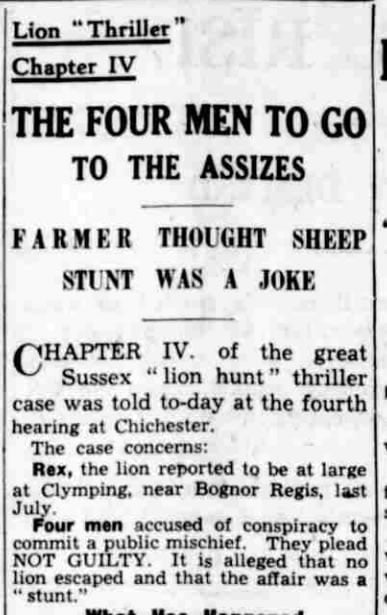
On October 23, 1933, some newspapers referred to this case as "Lion Thriller - Chapter IV" as it began its fourth hearing. This time, it was the farmer, Mr Wensley’s opportunity to recount his version of events. He confirmed that he was given 30 shillings to acquire a sheep, which was killed in a manner that suggested the lion was responsible. When questioned, Mr Wensley confirmed that Mr Proctor was the one who compensated him, saying, "he had a little game on -- a bit of a stunt, but I thought it was a bit of a joke, and I didn't want to get involved." Mr Wensley informed the court that the journalist aimed to make the public believe that the lion was still on the loose.
On the day the sheep was killed, Mr Wesnley testified in court that Mr Proctor had given him Billy Butlin's phone number and instructed him to contact Butlin in the morning to inform him that he had found a sheep he believed was killed by a lion. Billy Butlin wanted to investigate this matter immediately and came out with his team to examine the sheep and see if it appeared to have been attacked by a lion. Mr Wesnley then mentioned to the court that this was the first time he had met Billy Butlin. Mr Flowers started to pose questions, stating, "I suppose you realised that you were practising a deception on the public?" The farmer responded, "I did not realise anything about it, I thought he was having a joke" At that point, Mr Flowers thought of an important question to ask, "I suppose you mean you did not realise the seriousness of it?" The farmer replied, "Yes, that's right."
Mr. Wensley informed Mr. Flowers that he genuinely believed there was a lion on the loose, recalling the previous week when a vegetarian lion had escaped before being captured. With so many rumours circulating, he was uncertain whether it was a fabrication or the truth. Mr. S. Falconer, the attorney representing Mr. Wensley, stated in court that his client was an innocent party who sought no publicity. After the questioning concluded, the magistrates, following a brief deliberation, determined that there was sufficient evidence for the investigation to proceed to the superior court at the Lewes Assizes, as noted by Billy Butlin on page 95 of his book (The Billy Butlin Story). Bail was set at £100 for each individual.
On December 20, 1933, the Lion Hunt Sequel case commenced at the Sussex Assizes court in Lewes, presided over by Mr Justice Charles, as noted on page 95 of the Billy Butlin book. Mr J. D. Cassels, K.C., represented Billy Butlin and Mr Joste, and questioned P.C. Smith regarding his responsibilities in Pagham, specifically whether he felt alarmed and was armed for any potential confrontation with Rex the lion. P.C. Smith responded, "No, I was not armed." The purpose of this inquiry was to convey to the court the sentiments of the affected communities by asking what the police had observed in the area following the news of the lion's escape—whether there were more or fewer people present. Additionally, the evidence sought to understand the police's feelings on the matter: did he feel frightened or not about this news?
The newspaper articles start to change, with some starting to realise that Billy Butlin was not actually aware that the lion was still in Skegness when the news broke regarding its escape. At that time, he was informed that the lion should be with them, and with an empty cage, the only possible explanation was that the lion had escaped until he was later informed by Ernest Newscome that it was a mistake and the lion was safe in Butlin's Skegness zoo. Billy Butlin would later provide testimony in the Assize court, explaining that he had spent most of the morning avoiding the many journalists who had come to seek more information about the story of the missing lion. When questioned about the sheep that had been found, Billy Butlin replied, "I asked Wensley if he had any sheep killed by dogs recently, and he said he had not. I thought to myself at that moment that my lion had killed the sheep."
Billy Butlin went on to explain to the court that he was determined to catch Rex before any further actions could take place. It was not until later that day that he received information from his Skegness park that Rex was still there and had not been transported to Bognor Regis as planned. Once again, Billy Butlin was questioned about the possibility of using this false news for publicity. He responded, "If this had been for publicity, I could have provided a detailed narrative of its recapture. Instead, I killed the story immediately," referring to the announcement that Rex had been recaptured and was now in the zoo, safe from harm.
Mr. Justice Charles inquired, "Was it not a bad advertisement to you, as an experienced showman, that a lion should have escaped from a weak or damaged crate?" Billy Butlin did not hesitate to reply, "Yes, it was a poor advertisement, and has done more harm to me than people think". Billy Butlin felt the mounting pressure as he was questioned about the choices regarding the crates being utilised, the lorries, the drivers' responsibilities, and how the story was conveyed to the newspapers. Nevertheless, he consistently responded with confidence and honesty. It was later revealed that the empty cage discovered on the lorry was actually intended to be delivered to an address in London, specifically Tottenham Court Road, but it never arrived there due to a road issue at that time.
Albert Gray
Albert Gray served as the zoo manager at Butlins Bognor Regis and mentioned that he received a list of animals expected from Butlins Skegness Zoo, which included a lion named Rex. After completing the checks and noticing the empty cage, he assumed that the lion had escaped, prompting him to inform Billy Butlin. When questioned about his response, Mr Albert Gray stated in court, "he instructed me to keep things as quiet as possible and to make inquiries."
Taking the stand was Mr. Proctor, who believed that the Butlins Lion had escaped and was a danger to those in the vicinity. He denied that the original story was his but conceded that he had contributed some details and materials. When pressed about the sheep, Mr. Proctor acknowledged that he was the one who devised the idea, intending it as a joke that backfired. Mr. Justice Charles, however, did not find it humorous and asked, "Is that your idea of a joke? You paid thirty-five shillings and left the carcass under a hedge." The reporter responded, "partly as a joke and partly for gaining copy for the news." He went on to admit that Billy Butlin and Mr Joste were not informed about the sheep idea, which he created to mislead people into thinking that Rex was out roaming the fields.
Source: Portsmouth Evening News - Thursday 21st December 1933.
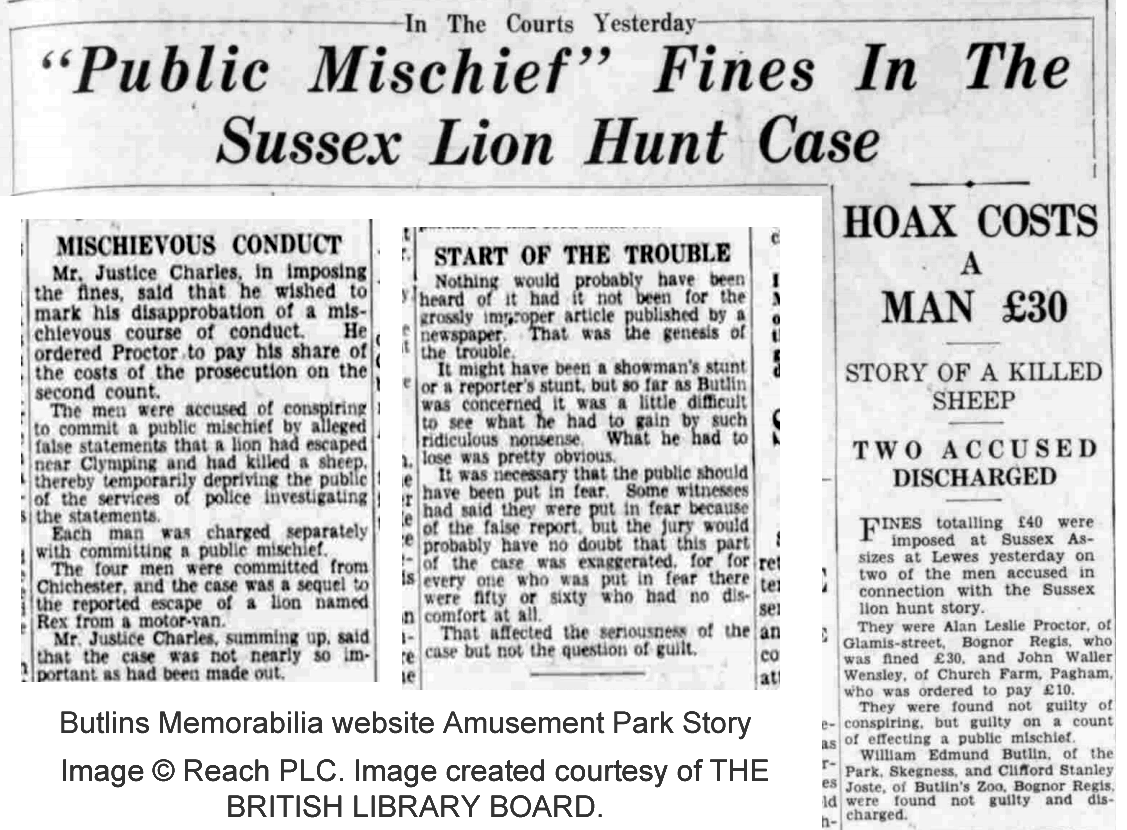
It was the last day of the court proceedings, and the verdict had been delivered along with the repercussions of everything that transpired. Tension filled the air as everyone awaited the outcome of the case. Here is what was announced to them,
Mr. Alan Proctor
Found Guilty of Committing Mischief
Not Guilty of Conspiracy
The court found Mr. Proctor guilty and imposed a fine of £30, a significant amount in 1933. Along with the fine, he was also required to cover his portion of the prosecution costs for the second charge.
Mr. John Wensley
Found Guilty of Committing Mischief
Not Guilty of Conspiracy
Mr. Wensley was similarly found guilty for his involvement in the case of the dead sheep and was fined £10. However, it is crucial to mention that Mr. Proctor was not found guilty for
Mr. Clifford Joste
Found Not Guilty
Mr. Joste was acquitted of the charges and was released.
Mr. Billy Bulin
Found Not Guilty
Mr. Butlin was also acquitted of the charges and was released.
The story of the Butlins Lion Rex has come to a close, and it can be confidently stated that Billy Butlin gained another significant lesson in his collection of experiences. Completely free from any issues related to the events that unfolded, it demonstrated that Billy Butlin was right to speak the truth, but there was an essential lesson to be learned. This lesson revolved around communication and ensuring that such incidents do not happen again, for two reasons: the need to make sure that the local community are seeing the positive side of Butlin's offers, which are tied to his reputation, and the second reason is connected to the damage it had caused to his company's name. Declared not guilty, the newspapers reported that Billy Butlin faced no charges. In his book, he recounts sending a telegram to his mother, Bertha Butlin, about the verdict, to which she humorously replied, "Appeal at once." A story that spanned two days and evolved to nearly a year, it would have been a long journey for him to navigate.
Mark's thoughts about this research
An interesting story to add to the Butlins Memorabilia website and one I had the feeling of wanting to know more about as I read about it in the number one source of information about Butlins, the Butlins Story by Billy Butlin. Rex the lion is remembered on this website as an important animal that did nothing but became famous for doing nothing but look great! If that is not a Butlins story, then what is. As I learnt more about Rex, I would discover that he is a very important part of the history of Butlins and had to be acknowledged.
In the photo above, we a very important moment and the reason for that is because of three reasons,
1. Billy Butlin is featured, a young business man who had done a great deal over the years to reach this point,
2. The dodgems is featured, a ride that became famous thanks to Billy Butlin and
3. The young lion at the time, which we would all know as Rex, the Butlins Lion.
The description for this photo has "Having a ride with "Rex" - Mr William Butlin riding one of his "bumper" cars with Rex, the African lion whose reported escape from a cage between Clymping and Bognor last July had a sequel at the Sussex Assizes at Lewes last week.
I am truly honoured to present this story to you all and I do hope you enjoyed my hard work.